Impressive résumés don't automatically become effective governance. Board Value measures whether the expertise your governance depends on is actually present, actually being used, and actually distributed, and not simply whether impressive people occupy board seats.
Every Board Value assessment asks five questions:
Is the capability present?
Is it activated?
Is it distributed?
Is independent thinking preserved?
Can the board sustain it over time?

Does the board have the right people to govern effectively?
The Baseline Literacy Principle
Every governance domain; cybersecurity, capital allocation, M&A, whatever the business actually depends on, needs three tiers present on the board, not just one strong voice.
An Anchor, anchors who have actually led it.
A Secondary Interpreter that can challenge and translate it, enough to catch what the anchor misses.
Some form of Baseline Literacy that means every other director has enough grounding to participate and not defer blindly.
A board with one brilliant cyber expert and four directors who nod along isn't covered, it's dependent. If that one director leaves, the board doesn't lose a director. It loses governance capacity.
Design Before You Diagnose
Most board evaluations start by looking at who's already there and asking whether they're good. Board Value starts differently: the ideal board; what the company will need, at what depth, and covered through which channel, gets designed before anyone looks at the current roster. Starting from the existing board anchors the evaluation to what's familiar; starting from what the business needs doesn't.
Presence Isn't Activation
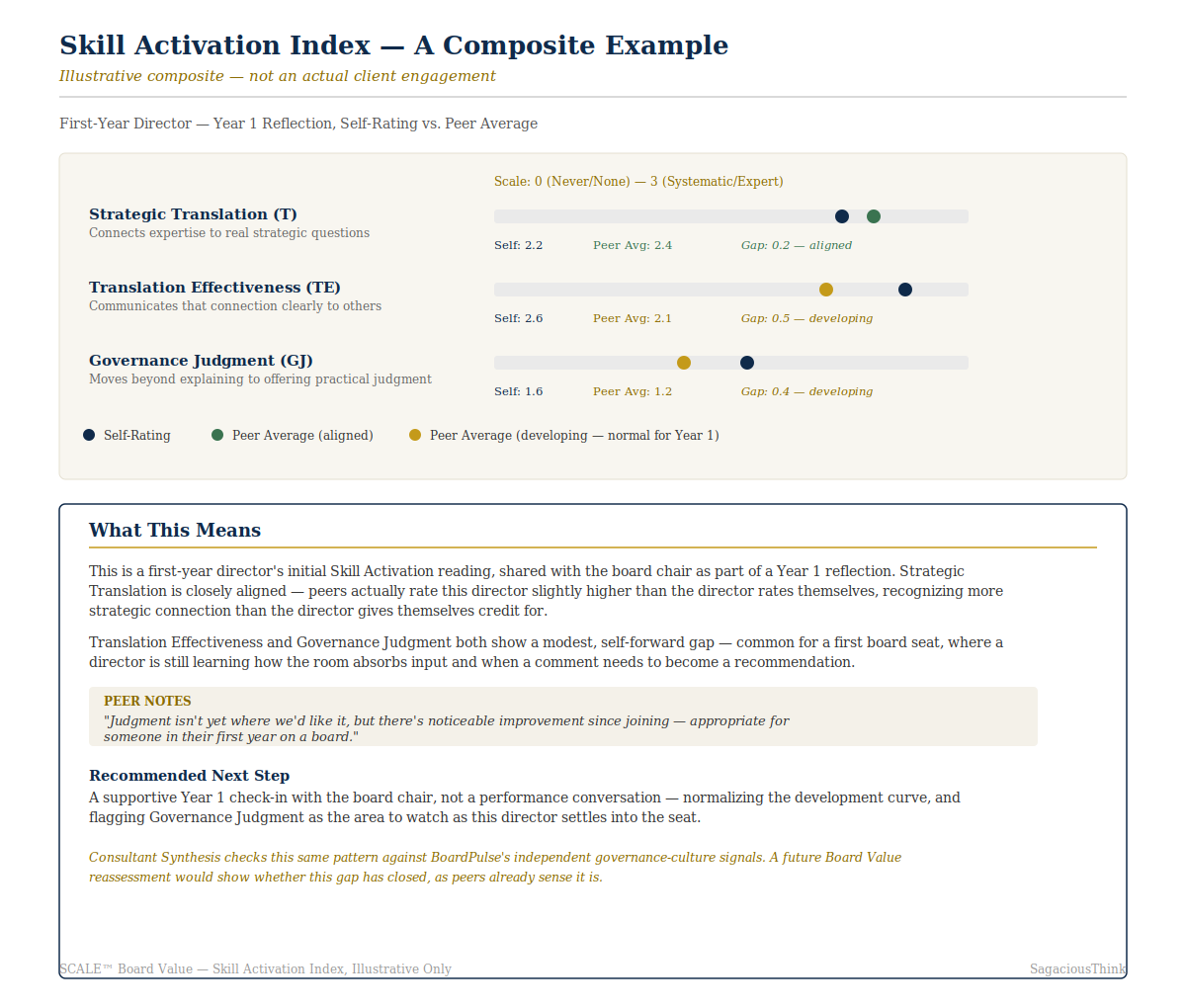
Expertise creates value only when it's brought into the room at the moments it matters. Having the right expertise on paper isn't the same as that expertise shaping how the board governs. The Skill Activation Index measures both: each director rates their own presence and activation in a domain, and their peers rate them anonymously, a different exercise than a traditional self-assessment, precisely because no one is grading their own homework alone.
The gap between those two views, what a director believes they're contributing and what the room experiences, is often the more useful finding than either score alone.
Activation itself isn't one thing. A director might connect their expertise to the company's real strategic questions (Strategic Translation), but struggle to explain that connection in a way the room can use (Translation Effectiveness), so that it is technically present, but practically inaccessible. Or a director might explain an issue clearly without ever pushing toward a decision (Governance Judgment), they’re informative, but not actually governing. Board Value tracks all three separately, because a director can be strong on one and quietly absent on another, and averaging them together would hide exactly the gap worth knowing about.
Beyond Diversity: Cognitive Convergence
Independent thinking is one of the board's greatest responsibilities. Yet boards often become intellectually concentrated in ways that aren't immediately visible. Board Value tracks this directly.
A board can look diverse while still approaching every important decision from remarkably similar assumptions.
From Finding to Action
Findings translate into a specific governance response, not just a diagnosis. Succession Risk flags gaps across five tiers, from Critical to Advisory Offset, where a gap may be partially covered by someone in the advisory pipeline, so the board knows not just where risk sits, but whether it's already being managed.
The Advisory Board as a Governance Pipeline
The strongest boards don't begin evaluating directors after they're appointed. They begin long before. BoardValue treats an advisory board as more than a source of expertise or introductions, it becomes a structured observation period: a chance to see how someone thinks, challenges assumptions, collaborates, and contributes before governance responsibility is formally entrusted to them.
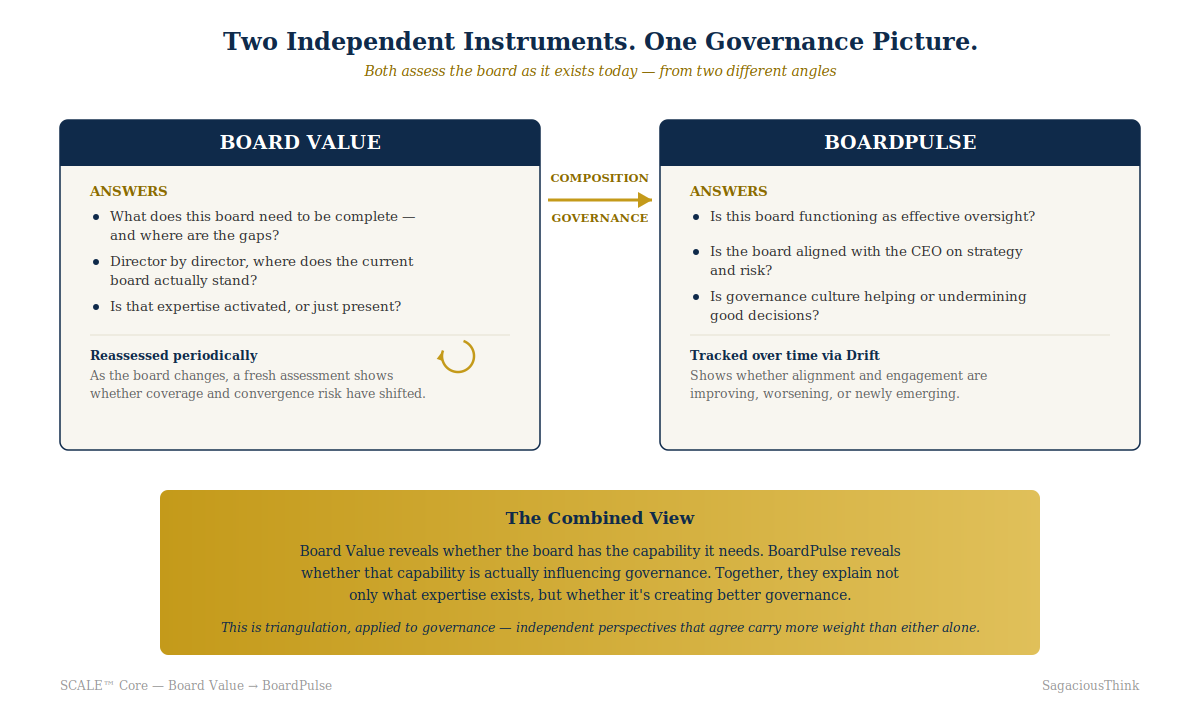
Board Value findings don't stop at the board's own data, it cross-references perception gaps against independent signals. A director whose peers rate them low on activation, checked against whether BoardPulse's governance-culture findings show the same pattern from a completely different angle. When two independent perspectives agree, that's not a coincidence. It's the independent validation that drives informed decisions.
Where This Leads
A BoardValue assessment is often the first of two steps, not the whole picture. Composition is only half the question, and BoardPulse picks up from there, measuring whether the board is actually using what Board Value found it has.