
Organizations aren't just strategies. They're structures. And structures either bear weight, or they don't.
Before any SCALE™ instrument makes sense; before a score, a signal, or a finding means anything, there's a belief underneath all of it: that an organization's ability to scale, govern, and endure isn't a matter of talent or ambition alone. It's a matter of architecture.
Why “Load-Bearing” Isn't a Metaphor
SCALE is built around five load-bearing pillars, and that word is chosen deliberately, not decoratively. In a load-bearing structure, removing one element doesn't just weaken that one part, it destabilizes everything resting above it.
That's not a metaphor for how organizations work. It's a description, as a company can have a brilliant strategy and still fail; not because the strategy was wrong, but because nothing underneath it could hold the weight of executing it. A board can look diverse and well-credentialed and still fail at oversight, and not because any individual director is unqualified, but because the structure connecting their expertise to real decisions was never built. Remove the right element, and everything above it becomes unstable, even if it looks fine from the outside for a while.
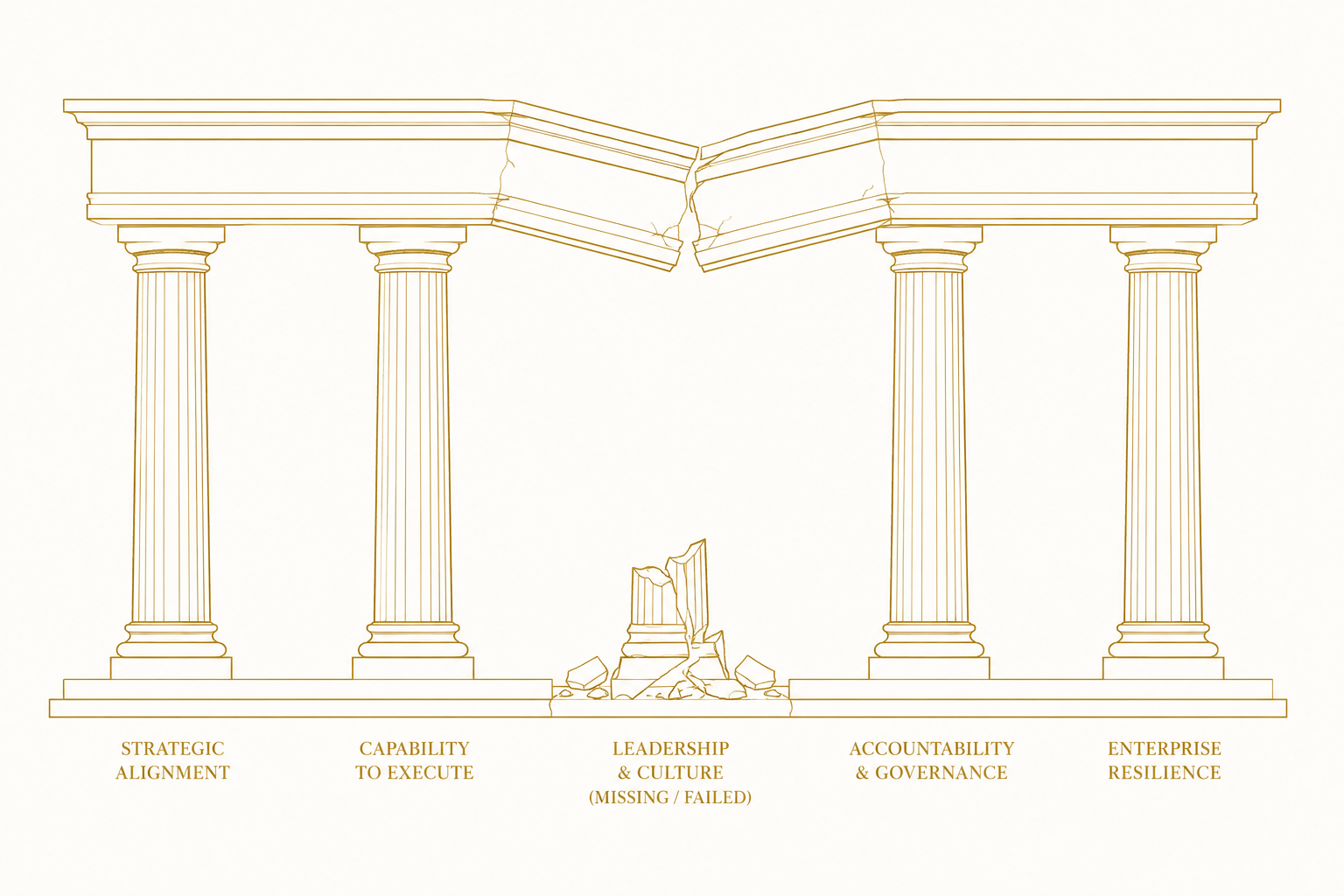
The Five Pillars
SCALE isn't just a name for the methodology. It's built from the five pillars themselves: Strategic Alignment, Capability to Execute, Accountability & Governance, Leadership & Culture, Enterprise Resilience. The framework is called what it measures.
Three of these pillars are structural columns - the load itself. One is the medium that connects them. One is the test of whether any of it holds.
Strategic Alignment
Whether the organization has a current, stress-tested view of its own direction, and whether that view actually reaches the people responsible for executing it.
Capability to Execute
Whether the organization has the structural capacity — not just the people, but the systems, processes, and decision rights — to deliver on what it says it will do, at the scale it's attempting.
Accountability & Governance
Whether responsibility is clearly assigned, understood, and enforced, not just documented.
Leadership & Culture
The connective medium through which every other pillar operates. Strategy doesn't execute itself. Governance doesn't enforce itself. Systems don't coordinate themselves. Leadership and culture determine whether those structural elements actually connect, or remain isolated pieces that never become a functioning whole.
Enterprise Resilience
Not another capability layered beside the others. It's the result of all of them working together. Organizations don't discover resilience during calm periods. They discover it when markets shift, leaders leave, growth outpaces the infrastructure meant to support it, acquisitions happen, regulations change, or technology forces adaptation. Pressure doesn't create resilience, it reveals whether the underlying structure was ever capable of carrying the load.
These weren't chosen as popular management categories. Recurring organizational failure, across industries, traced back to weakness in one or more of these five conditions.
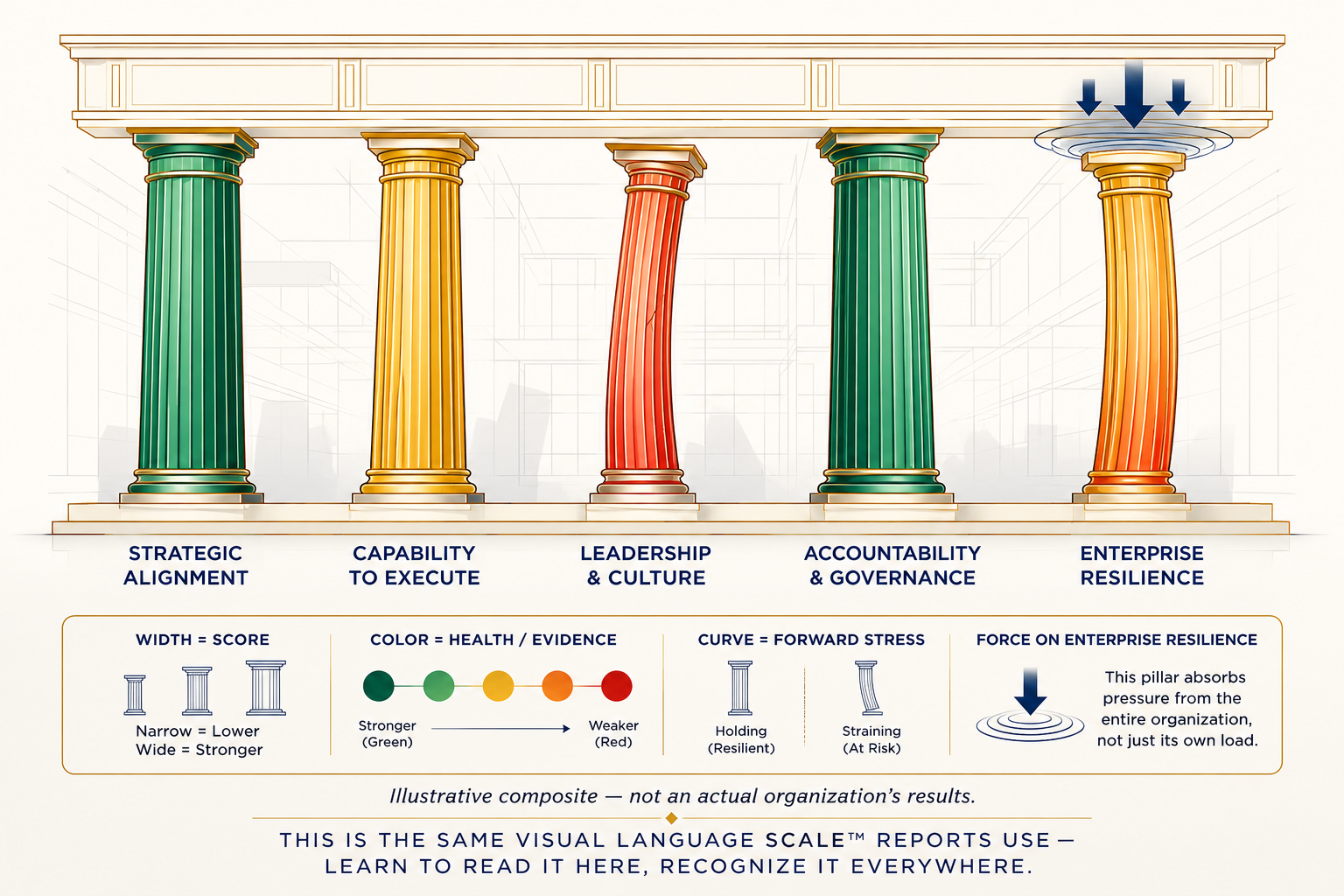
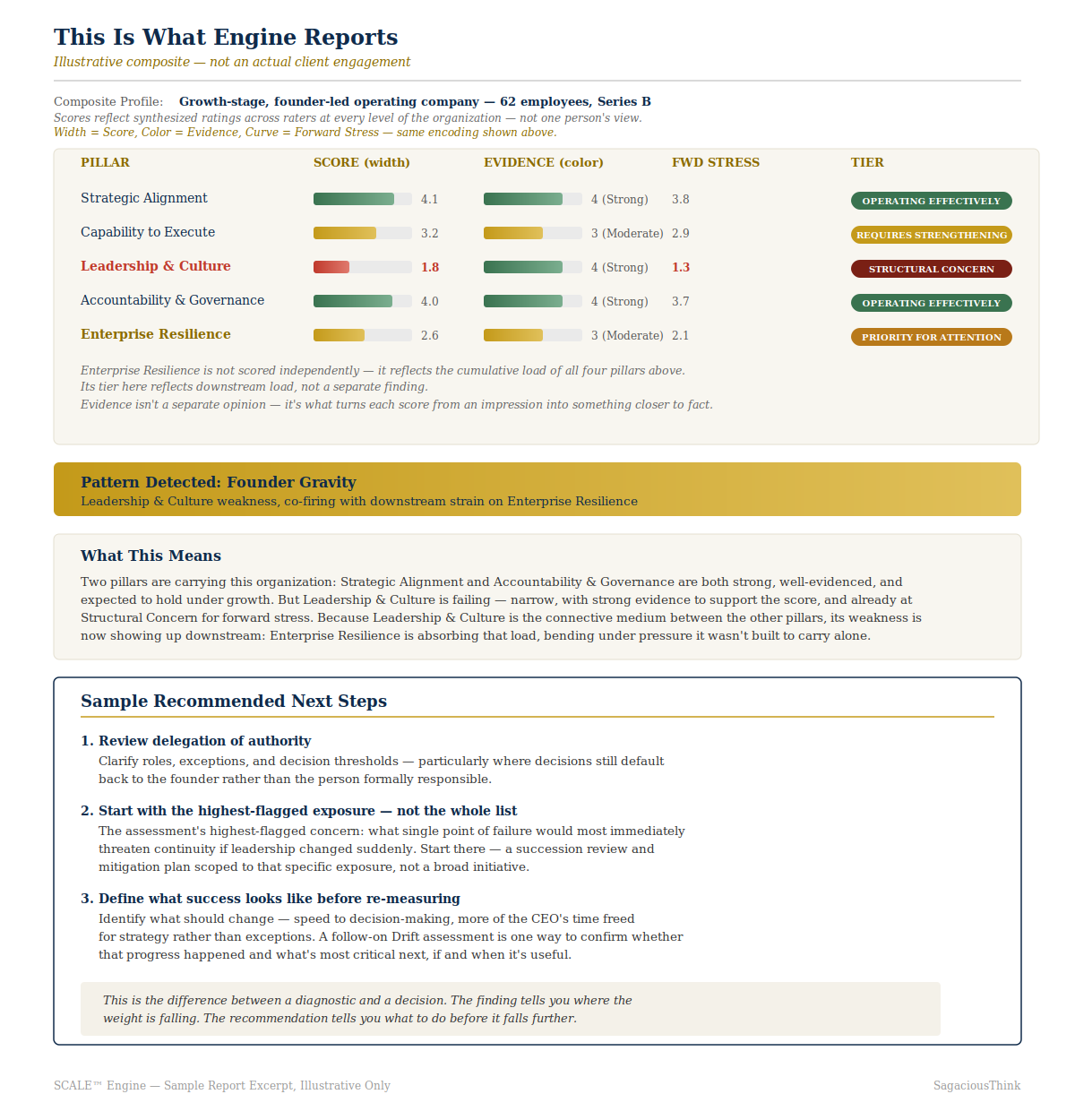
Where the Seam Lives
The first three pillars correspond directly to the three disciplines at the center of SagaciousThink: Strategy, Operations, and Governance. The pillars describe the structural conditions each discipline depends on, rather than the disciplines themselves.
The other two aren't a fourth and fifth face. They describe the seam itself; the medium connecting the three, and the test of whether that connection holds.
Why This Matters Before You Look at Any Tool
None of SCALE's instruments make sense without this belief underneath them. The Engine doesn't just ask how an organization is performing, it asks whether the structure producing that performance will hold under more weight. BoardPulse doesn't just ask whether a board is engaged, it also asks whether governance is structurally connected to what leadership actually sees. Board Value doesn't just ask whether directors are qualified, it determines whether their expertise is structurally activated, not just present.
If you don't believe structure matters more than a performance snapshot, none of these findings will look like anything more than opinions with extra steps. If you do, they start to look like exactly what they are.