
sage ideas | fresh perspective | sustained success

Sagacious Thinking

Periodic musings

Governance Drift: The Risks Boards Don't See Until They Become Outcomes

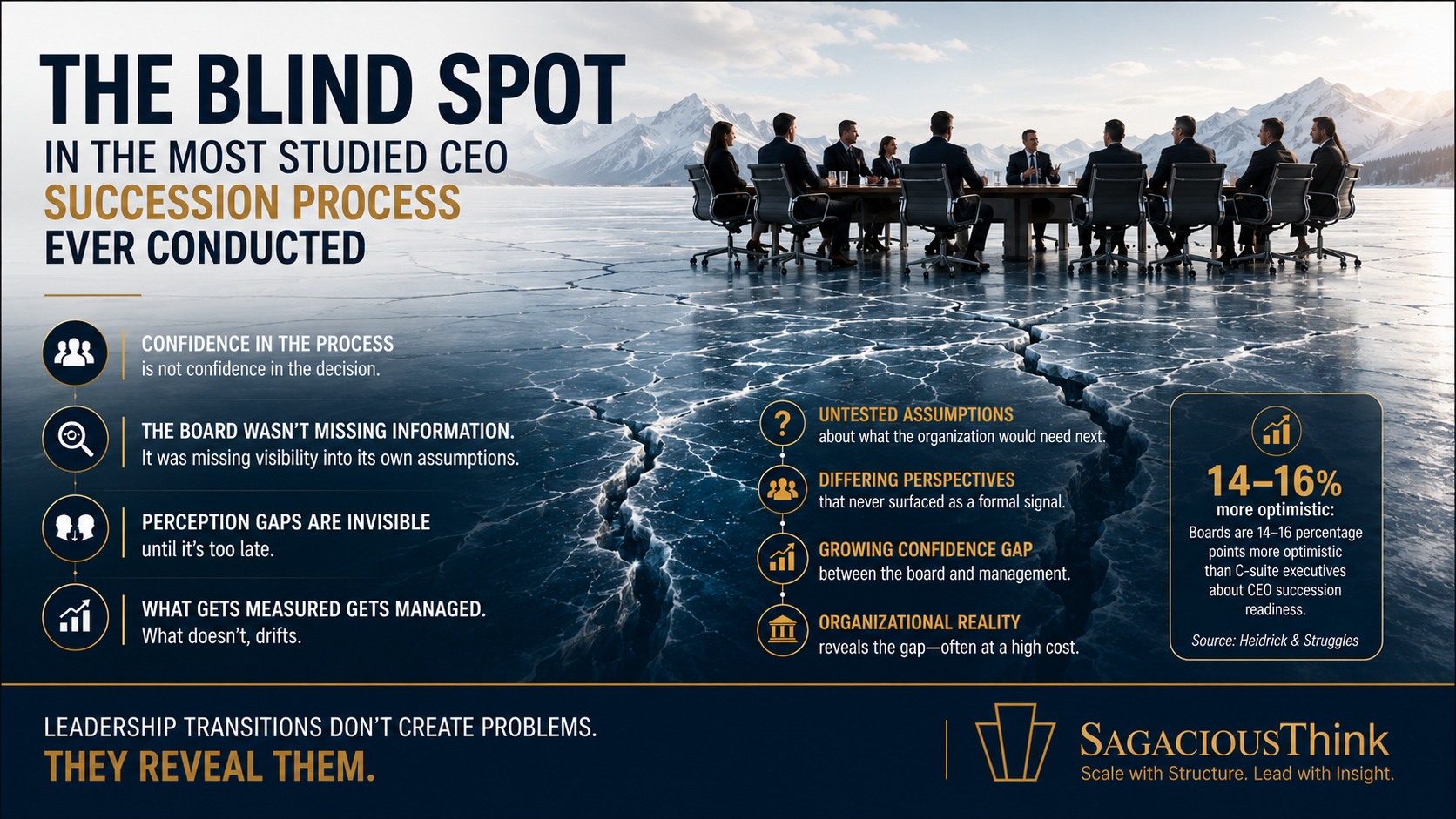
A frozen lake can appear solid right up until the moment it breaks.

Organizations are often no different. Most governance failures don't begin with a crisis. They begin with subtle shifts that remain hidden while performance is still strong.

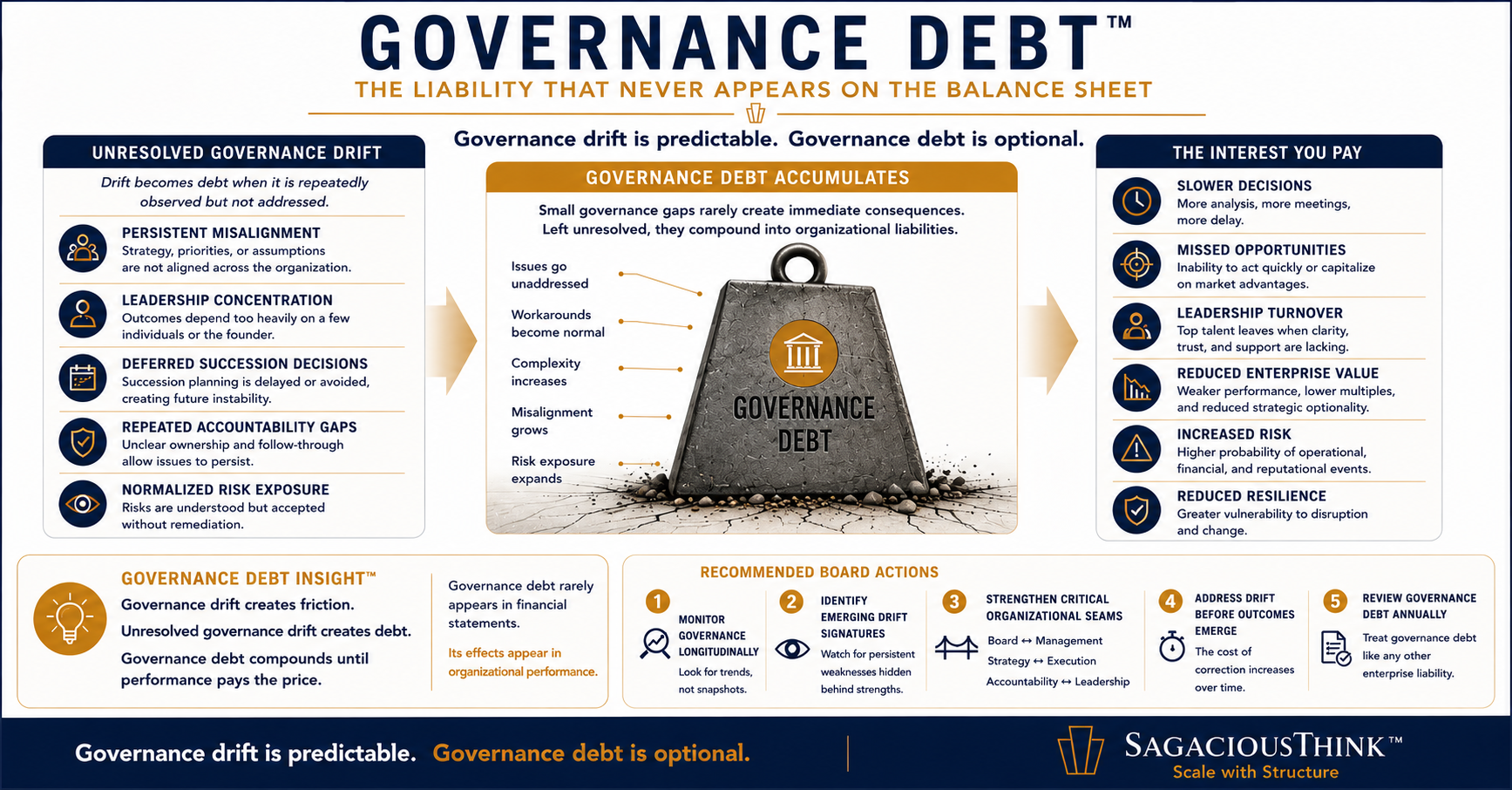
The strongest boards don't wait for red flags. They look for early signs of governance drift before drift becomes governance debt and debt becomes consequence.

Because organizations rarely break all at once. They drift there first.
Read More
The AI Resilience Gap

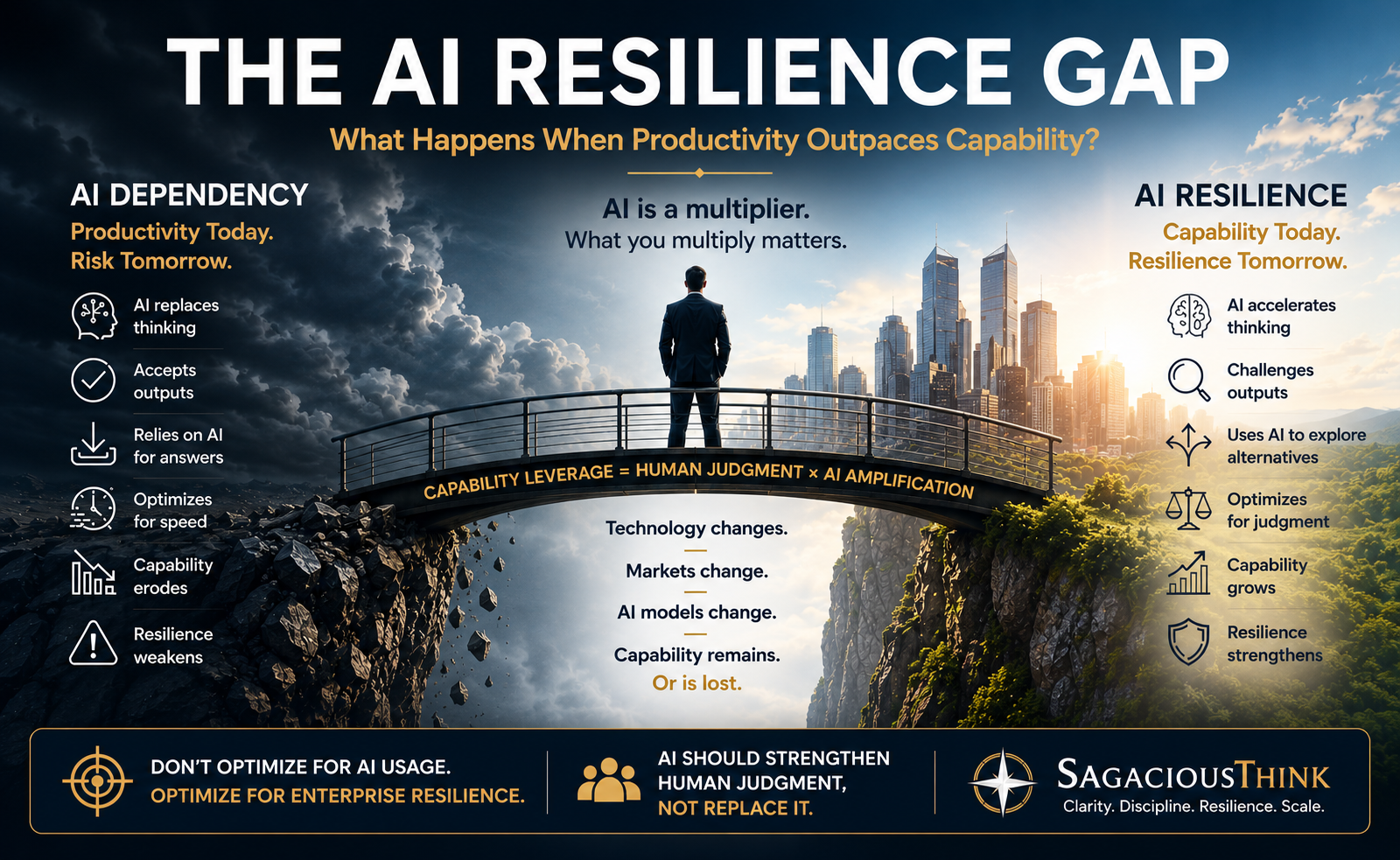
Most organizations are asking: "How quickly are we adopting AI?"


Few are asking: "What capabilities are we losing in the process?"


As companies race to increase AI usage, a critical question is emerging:

Are we building more capable organizations, or more dependent ones?


In this article, I explore the growing AI Resilience Gap: what happens when productivity gains outpace capability development, why incentive structures matter, and how leaders can ensure AI strengthens judgment, institutional knowledge, and enterprise resilience rather than quietly eroding them.

The goal should be sustainable performance under increasing complexity, not AI adoption.

Read More
The Most Dangerous Scaling Problem Is Imbalance

Scaling problems rarely begin with collapse.

They begin with friction organizations normalize: slower decisions, leadership overload, coordination fatigue, delayed visibility,
and rising operational strain.

Many companies continue growing while structural imbalance quietly compounds beneath the surface. In this article, I explore five recurring imbalance patterns that appear across scaling organizations:
• Visionary Strain
• Founder Gravity
• False Stability
• Coordination Breakdown
• Governance Theater

Using examples including WeWork, CrowdStrike, and Boeing, the article examines how uneven organizational maturity creates hidden fragility long before financial underperformance appears.

Because scaling is never symmetrical, and complexity eventually exposes the gaps.

Read More
LouAnn ConnerComment
Governance as Performance Architecture

Most companies do not realize they have a governance problem until growth starts creating friction.

Decisions slow down.
Coordination weakens.
Risks surface too late.
Leadership becomes the bottleneck.

At a certain point, every organization reaches a complexity threshold where informal leadership systems stop scaling effectively.

The companies that navigate this successfully understand something important:

Governance is not bureaucracy layered onto performance.

It is part of the architecture that makes performance possible.

In this article, I explore:
• why governance failures are often actually execution failures,
• how structural friction quietly undermines scaling companies,
• why governance maturity increasingly shapes operational performance,
• and how organizations can build governance into the architecture of execution itself.

Including:

  • a real-world scaling case study,

  • leadership and board discussion questions,

  • and practical insights for organizations navigating increasing complexity.

Read More
When Growth Outpaces Structure

Growth does not simply create more work. It changes the operating conditions of the organization itself.

As middle market companies scale, complexity expands across operations, governance, risk oversight, decision-making, cross-functional coordination, cybersecurity, AI adoption, regulatory exposure, and leadership accountability. Yet many organizations continue operating with structures designed for a much smaller business.

The result is often not immediate failure, but growing organizational strain: slower decisions, leadership bottlenecks, execution friction, governance gaps, declining operational visibility, and hidden enterprise risk that boards and leadership teams may not fully see until performance begins to suffer.

This article explores why scaling challenges frequently emerge not because growth opportunities are weak, but because organizational maturity, governance discipline, and operational structure are not evolving at the same pace as organizational complexity.

Read More