
Core instrument
The Engine
Organizations rarely fail because someone couldn’t describe how things were going. They fail because today’s performance concealed tomorrow’s structural constraint.
The Engine measures those structural conditions directly: whether the organization is built to sustain growth, increasing complexity, and leadership transition, not just whether it’s performing well today.
The name reflects what’s being measured. Not the organization’s destination, but the machinery converting strategy into sustained execution, and whether that machinery will hold under greater load.
What it measures
The Five Pillars
The Engine is built around five load-bearing pillars: Strategic Alignment, Capability to Execute, Accountability & Governance, Leadership & Culture, and Enterprise Resilience. Each is a structural condition an organization needs to scale — not a category or a theme. Remove or neglect one, and the pillars above it become unstable.
One
Two
Three
Four
Five
Who it asks
Multiple vantage points
The Engine gathers perspective from across the organization: Executive, Senior Leadership, Middle Management, and Frontline, because each level sees a different part of the truth, and each has a documented blind spot. Executives often can’t see capacity strain building beneath them. Frontline staff often can’t see whether strategic intent is real, only whether it reaches them.
Executive
Senior Leadership
Middle Management
Frontline
When two levels agree, that’s confirmation. When they diverge sharply, that gap is often the finding, not noise to average away.
How it reads
Not just what’s true today — what will hold
Most assessments ask a single question: how are things going? The Engine asks three, on every question it evaluates:
Together, those three answers give a single score real meaning. A high score with weak evidence and poor forward stress is a fundamentally different finding than a high score backed by verified practice expected to strengthen under growth, even though both might show the same number on the surface.
What you get
From finding to action
A finding without a next step is just a more detailed way of saying something is wrong. Engine is built to avoid that. Every pattern it detects — a capability gap, a leadership dependency, a strategic disconnect — comes with structured facilitation guidance: the probe questions to ask, what the pattern means for the board or CEO specifically, and where to focus first.
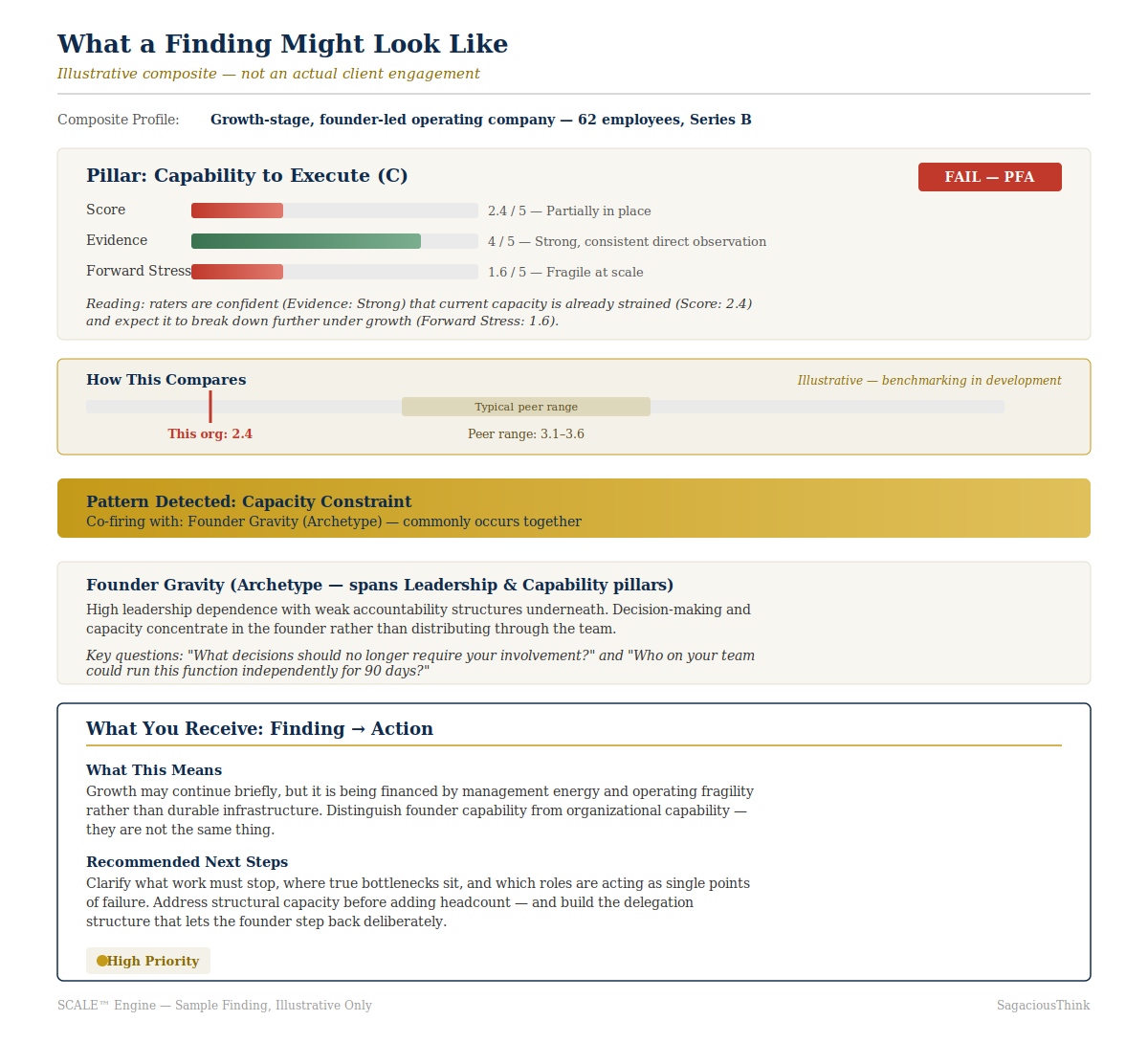
Take Founder Gravity — a pattern where decision-making and capacity are concentrated in a single founder or leader, with weak structures underneath to support delegation. Engine doesn’t just flag it. It comes with the specific questions a facilitator asks to surface it (“What decisions should no longer require your involvement?”), guidance on how to frame the conversation so it lands as evolution rather than critique, and what it means: founder capability and organizational capability are not the same thing, and conflating them is a risk in itself.
This is what separates the Engine from a report that sits on a shelf. The output isn’t just “here’s what we found” — it’s “here’s what to do about it, and how to talk about it with the people who need to hear it.”
This matters most in the first 100 days of a leadership transition. A new CEO inherits an organization’s structural reality whether or not anyone’s told them what it actually is, and the Engine gives them that picture on day one, rather than several months into learning it the hard way.
Where this leads
Where this leads
The first Engine assessment establishes a baseline; a structural read of where the organization stands today. That baseline isn’t the end of the story. It becomes the starting point for Drift, which tracks whether those same conditions are improving, worsening, or newly emerging over time.
That last part matters more than it might seem. Addressing the most pressing structural gaps doesn’t just improve a score, it changes what becomes visible next. The condition that mattered most in the first assessment may no longer be the constraint; something that was masked behind it often is. Drift is built around that reality: it’s not just re-measuring the same list, it’s checking what the list has become.
As SCALE’s benchmarking capability develops, that same baseline will eventually show not just where an organization stands against its own trajectory, but against comparable organizations at a similar stage.
SagaciousThink is a strong fit if:
- Growth is accelerating faster than internal discipline.
- The organization is transitioning beyond founder-led execution.
- Expansion (new markets, entities, or capital) is introducing structural strain.
- Board and management roles feel blurred or misaligned.
- You are preparing for a capital event, liquidity transition, or integration.
- Governance expectations are increasing.
- The business performs, but feels more complex than it should.
SagaciousThink ensures the company strengthens as it scales.
Revenue measures momentum. The Engine measures whether the machinery producing that momentum is built to last.