
The AI Risks Are Becoming Clear. Can Your Board See How They Reach the Company?
A recent MIT Sloan article crystallizes something already high on the agenda for many boards and CEOs: AI risk is moving quickly, reaching organizations unevenly, and becoming harder to treat as a conventional technology matter.
Drawing on the structured judgment of 272 international experts, the underlying research prioritizes the AI risks considered most serious through 2030.
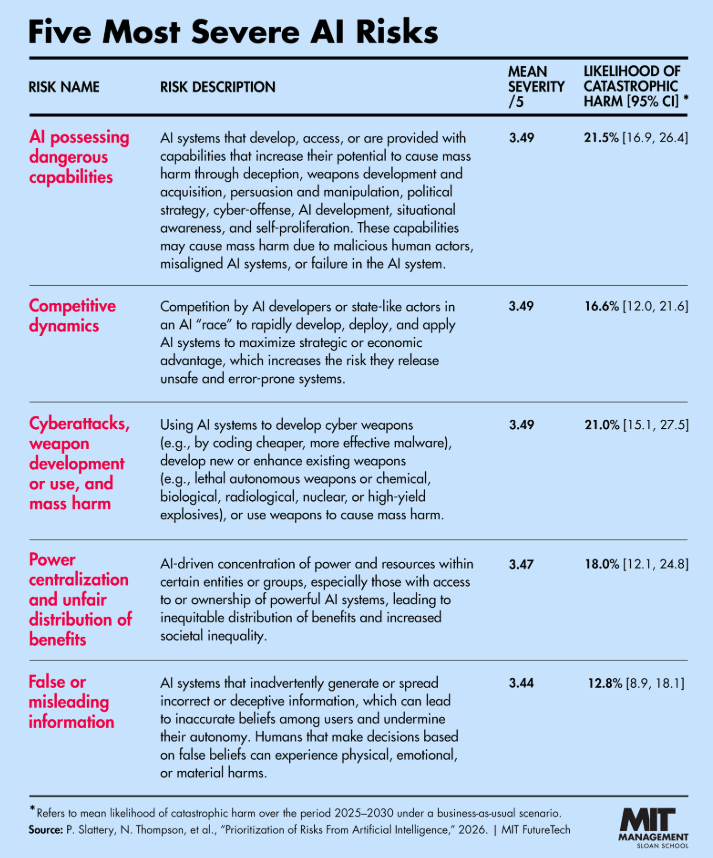
The study also identifies something more useful to a board than any single risk on the list: the people most responsible for mitigating AI risk are frequently not those most exposed to its consequences. The findings themselves are sobering, but for a corporate board, a list of global risks raises a targeted and more difficult question.
What do these risks mean for this company, and does the board have enough visibility to know?
That question is harder than it appears. A board generally knows AI presents risks without knowing where AI is already shaping customer decisions, workforce choices, operational judgments, financial outcomes, or the information reaching the board itself. A board may know that AI presents risks without knowing where AI is already shaping customer decisions, workforce choices, operational judgments, financial outcomes, or the information reaching the board itself. It may have assigned oversight responsibility without establishing clear decision rights. It may receive regular updates while remaining unable to see vendor dependencies, unapproved employee use, or whether competitive pressure is causing deployment to outpace the governance meant to govern it.
Knowing which risks experts consider most serious does not tell a board which risks its company is exposed to, whether directors and management see the same picture, or whether governance will hold as adoption accelerates.
The question that arrives from outside
For many boards, the concern becomes concrete not through an article, but through a request. That request may arrive inside a diligence packet, an insurance renewal, or an auditor's inquiry. For the company below, it arrives during an early transaction-readiness review, and it reads plainly enough: describe the board's oversight of artificial intelligence, including responsibility, reporting, and material exposure.
The following is an illustrative composite showing how an Advanced BoardPulse assessment could read. It is not a client case study.
Consider a $250 million industrial manufacturer, family-held, considering a transaction within the next two years. AI is not its product, so the board has never thought of itself as governing an AI-dependent business. But AI entered steadily and stealthily from several directions at once: predictive maintenance embedded in operating software, an AI-enabled scheduling platform, customer service tools, fraud and cybersecurity defenses, employee use of generative tools, and management's own preparation of analysis that reaches the board.
The board has discussed AI and assigned responsibility to the audit and risk committee. Management has adopted an AI-use policy and provides periodic updates. Most directors, if asked, would say AI governance is developing appropriately.
Yet when directors attempt to draft a common response to the external request, they find they can describe the structure far more easily than they can explain what evidence sits beneath it. Everyone can name the committee, but no one can produce a current, consolidated account of where AI is materially embedded, what decisions it influences, which systems the company depends on, or what would happen if a critical provider failed.
That gap — between what a board can describe and what it can substantiate — is not a documentation problem. It is a governance condition, and it can be measured.
What the assessment would reveal
On its face, the company's AI governance would read as reasonably established. The board's overall result on AI and technology governance would land at 3.6 out of 5, or adequate. A director reviewing that number alone would have no particular reason for concern.
The deeper findings would tell a different story.
Sitting inside that adequate composite would be a result of 2.4 for the board's visibility into where AI affects consequential decisions. BoardPulse treats that visibility as a load-bearing governance condition, so the weakness would surface independently rather than disappearing into the average.
The board could reasonably believe it had scored fine, while the condition most likely to surprise it remained hidden inside the average.
The pattern would deepen from there.
● The CEO would rate the board's visibility at 4.2 against the directors' own 2.4 -a 1.8-point gap, a point at which the divergence becomes a governance finding in its own right. Management would believe the board saw considerably more than the board believed it had received.
● Much of the directors' confidence would rest on management assurance rather than direct evidence. Some analysis reaching the board would already have been prepared with AI, yet directors would have no shared standard for when that use should be disclosed or what verification should stand behind it. AI would not only be something the board was governing; it would shape the information the board used to govern.
● Material AI dependencies would enter through purchased software, without consistently reaching the board as an AI governance matter at all.
● Employees would be using unapproved tools, and discomfort about admitting that use would push some of it out of view, causing management’s formal inventory to understate actual adoption. What appeared to be an IT compliance issue would also be a culture and visibility problem.AI knowledge would be concentrated in one or two directors rather than functioning as distributed board capability.
Most consequentially, the forward reading would drop. Against a current result of 3.6, the board's forward stress result would fall to 2.4 — a gap between the two readings wide enough to raise a flag, not merely a lower forward number. Governance appeared adequate today, but directors were materially less confident that the current approach would hold as AI use, competitive pressure, and organizational dependency increased.
The findings would not show that AI governance was absent. They would reveal something more uncomfortable and more actionable: the board's confidence would be stronger than the evidence and the durability beneath it would support.
What the board would do with it
An assessment that stopped at diagnosis would leave the board with a set of scores and no path forward. The value sits in what the findings make possible, and each recommendation would trace directly to the condition that produced it.
● Create a current AI-use and dependency map. Cover consequential decisions affecting customers, employees, operations, and financial outcomes, along with AI embedded in purchased software, critical vendors, concentration points, and contingency plans. Use the map to establish a shared baseline between management and the board, and to define what information must reach directors as AI use changes.
● Clarify authority and escalation. Establish what management may approve on its own, what requires committee or full-board visibility, and which changes or incidents require notification between meetings.
● Set standards for AI-generated governance information. Define how AI-generated analysis appearing in board materials, investor communications, and regulatory disclosures is identified, verified, and governed.
● Bring hidden adoption into view. Give employees a safe way to disclose actual AI use, so management can distinguish legitimate adoption from unmanaged exposure.
● Build distributed board capability. Provide company-specific AI education so that informed challenge does not depend on one or two directors, and then reassess whether visibility, alignment, and durability improved.
Notably, the recommendations would identify the governance actions most likely to improve visibility and durability, and they would establish a baseline against which improvement could be demonstrated.
Why reassessment changes the question
The first assessment asks what the board can see. The next asks what it did with what it learned. A reassessment would not simply ask whether the board had completed the recommended actions. Actions can be completed, while improvements must be demonstrated to avoid a false sense of comfort. It would show whether visibility had improved, whether the CEO and the directors had converged on a common picture, whether AI governance capability had become more broadly distributed, and whether governance was now more likely to hold under forward pressure.
If the same conditions persisted, the implication would be difficult to set aside. The board would have identified a governance gap, agreed that it mattered, and failed to produce measurable improvement. That is a materially different finding from not having known and would warrant a different response.
The distinction worth preserving
Boards do not need to predict which of the risks on MIT's list will materialize. They do need to know where AI is already influencing the enterprise, what evidence supports management's assurances, where responsibility sits, and whether the existing governance will hold as adoption accelerates. That is a different question from whether an AI policy exists. It is a question about whether the board can see clearly enough, and early enough, to govern.
SCALE™ BoardPulse was designed to examine those conditions. It does not calculate the probability that a particular AI harm will occur, and it is not a technical audit. It examines whether the board has the visibility, alignment, evidence, distributed expertise, and forward durability to govern the company's actual use of AI.
MIT sharpens the external signal. The harder work is translating that signal into something a board can act on before pressure, capability, and exposure outrun its oversight.
The scenario, scores, and findings are illustrative. The MIT findings reflect structured expert judgments over a five-year horizon, not actuarial forecasts or company-specific probabilities.