
Governance Drift: The Risks Boards Don't See Until They Become Outcomes
Introducing Governance Drift Signatures and the Case for Continuous Governance Monitoring
Executive Summary
Most governance failures never make headlines. They appear instead as missed growth targets, stalled acquisitions, leadership turnover, succession challenges, and valuation discounts that quietly compound over time. By the time the consequences become visible, the underlying conditions have often been developing for years.
The governance failures that do become public, such as BP, WeWork, major quality failures, and high-profile cyber breaches, are valuable precisely because they make visible what is usually invisible. They reveal a pattern that occurs in organizations of every size, across every industry and ownership structure. The difference is not that these organizations experienced governance drift while others did not. The difference is that their drift became impossible to ignore.
Most do not. A family business navigates succession tension quietly. A private equity-backed company absorbs leadership bottlenecks until execution suffers. A scaling enterprise fragments culturally while revenue continues to grow. The outcomes differ. The underlying pattern is often remarkably similar.
The challenge for boards and leadership teams is not understanding governance failure in retrospect. It is recognizing governance drift while there is still time to change the trajectory.
The Hidden Challenge of Growth
As organizations scale, complexity increases.
· New leaders.
· New business units.
· New geographies.
· Acquisitions.
· New investors.
· New stakeholders.
The systems that supported earlier success become increasingly strained. Many organizations continue growing while governance maturity remains largely unchanged. For a period, growth masks the underlying issues as the business appears successful. But the organization becomes increasingly fragile, creating a dangerous illusion. Leaders often assume that because performance remains strong, governance remains healthy. The two are not necessarily the same.
Governance Drift: A Different Way of Thinking About Risk
Most governance assessments attempt to answer: “How effective are we today?" A different question deserves consideration: "Are we becoming stronger or weaker over time?" This distinction matters because governance failures rarely emerge suddenly. Instead, organizations often follow a predictable progression.
Alignment
Leadership, management, and oversight bodies share a common understanding of priorities and objectives.
Complexity
Growth introduces new dependencies and operating challenges.
Drift
Different parts of the organization begin experiencing different realities.
Friction
Decision-making slows, accountability weakens, and execution becomes inconsistent.
Outcome
A visible event exposes the underlying condition. The outcome may be:
a safety incident
a failed transaction
a succession challenge
a cyber breach
a missed growth target
a valuation discount
The event may change perception, but often not the patterns that preceded it.
Why Drift Is Difficult to See
Governance drift rarely begins within a single organizational dimension. More often, it emerges at the seams between strategy, execution, governance, leadership, and resilience.
As organizations become more complex, these connections experience increasing strain. Different stakeholders begin experiencing different realities as information slows, accountability fragments, and assumptions go unchallenged. This is where governance drift often begins.
Three Governance Drift Signatures You May Recognize
One of the most important lessons from governance failures is that organizations rarely deteriorate in the same way. Different organizations develop different Governance Drift Signatures. The objective is not simply identifying weaknesses.
It is understanding how strengths and weaknesses interact over time. This is a critical distinction, as governance drift rarely occurs because everything becomes weak. More often, organizational strengths continue masking emerging vulnerabilities. The danger lies in the imbalance.
Governance Drift Signature #1
Risk Normalization
Illustrative Example: Energy & Industrial Operations
The Deepwater Horizon disaster became one of the most significant operational failures in modern corporate history. The example provides insights across industries. The issue was not a lack of technical capability as BP possessed extraordinary operational expertise. The challenge was the interaction between risk, accountability, and organizational alignment.
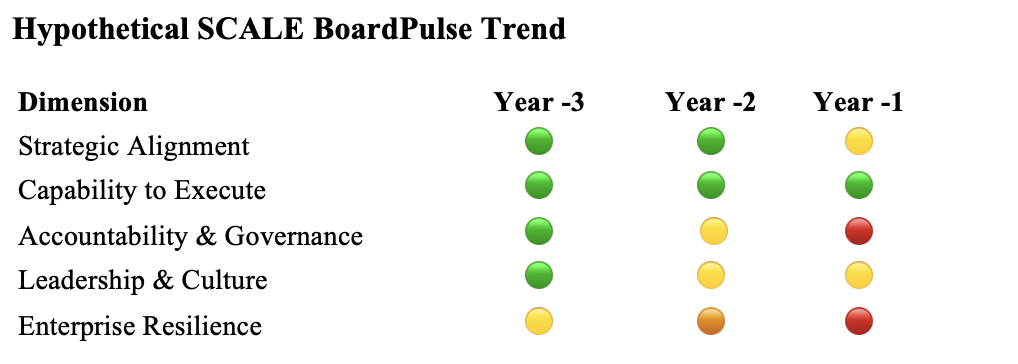
Notice what remains strong: the Capability to Execute remains green. The organization still knows how to execute and can mask the drift occurring elsewhere.
Board Questions
Which risks are becoming normalized?
What concerns continue appearing without resolution?
Where are performance objectives competing with resilience objectives?
Governance Lesson
Organizations rarely fail because they lose capability; they often fail because accountability, resilience, and alignment deteriorate while capability remains strong.
Governance Drift Signature #2
Founder Dependency
Illustrative Example: Founder-Led Growth Company
The WeWork story is often described as a governance failure, when it can more accurately be described as a governance drift failure. As the company scaled, leadership concentration increased faster than governance maturity.
Hypothetical SCALE BoardPulse Trend
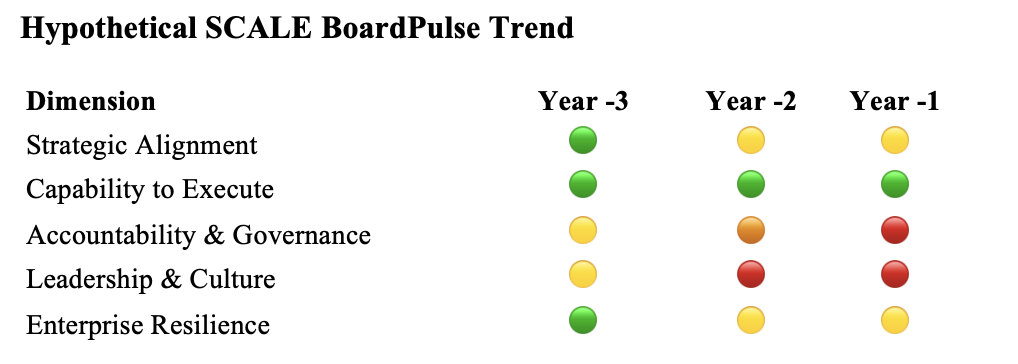
Again, capability execution and growth remain strong. The challenge emerges in leadership concentration, governance maturity, and alignment.
Board Questions
Which decisions remain dependent on a single individual?
Where are challenge mechanisms becoming weaker?
What perspectives are not being heard?
Governance Lesson
Growth magnifies strengths, but it also magnifies governance weaknesses.
Governance Drift Signature #3
Succession & Alignment Drift
Illustrative Example: Multi-Generational Enterprise
This may be the most common drift pattern among successful private enterprises. The business remains profitable, the customers remain loyal, the strategy remains sound, yet governance maturity fails to evolve alongside organizational complexity.
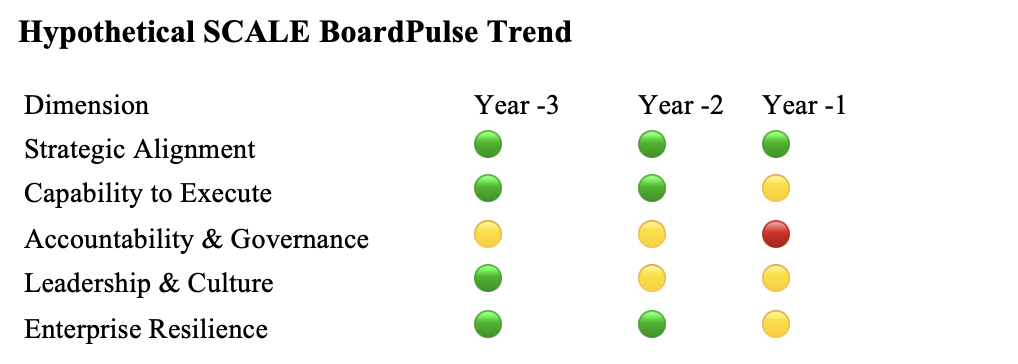
This is what makes governance drift difficult to detect, as most indicators remain healthy. The organization is not failing, yet future vulnerabilities are emerging.
Board Questions
Are family interests, ownership interests, and business interests aligned?
How prepared is the organization for a leadership transition?
Where are future leaders becoming disengaged?
Governance Lesson
Family businesses rarely struggle because of a lack of commitment. They struggle when governance maturity fails to keep pace with enterprise complexity.
Governance Debt
Unresolved governance drift leads to governance debt, with
· Informal decision-making.
· Delayed succession planning.
· Unclear accountability.
· Weakening challenge mechanisms.
· Board-management misalignment.
Initially, these create little visible impact. Over time, organizations begin paying interest through:
slower execution
increased risk exposure
missed opportunities
valuation discounts
reduced resilience
The challenge is that governance debt rarely appears in financial statements, which would make it easier to spot. Its effects appear through organizational performance.
Why Continuous Monitoring Matters
The purpose of governance is not simply identifying weakness; it is understanding how the balance of the enterprise is changing over time. Organizations rarely fail because every dimension deteriorates simultaneously. It is common for strengths to remain intact while vulnerabilities emerge elsewhere, and this is why longitudinal measurement matters. The board should not focus solely on what is red. It also needs to remain vigilant and focus on what remains green while other dimensions are quietly drifting.
Governance failures rarely occur when everything is weak. They occur when organizations become overly confident in their strengths while emerging vulnerabilities remain unaddressed.
Governance as Performance Architecture
Governance is often viewed as a compliance mechanism, but increasingly, it functions as performance architecture. Strong governance strengthens:
execution
accountability
leadership effectiveness
resilience
strategic alignment
It creates capacity, while weak governance creates friction. As organizations grow, governance maturity becomes increasingly linked to enterprise performance.
Conclusion
The most significant governance risks are rarely the ones organizations are actively monitoring. They are the ones developing quietly beneath the surface in the seams between strategy and execution, between board and management, between organizational strength and emerging vulnerability.
BP, WeWork, family enterprises, and private equity-backed companies across every market demonstrate the same underlying reality. The visible outcome is rarely the beginning of the problem. It is the point at which the drift that has been accumulating for years becomes impossible to ignore.
Boards that wait for red indicators to appear before acting are already behind. The organizations that navigate complexity successfully are not those that avoid governance drift, as that drift is a natural consequence of growth. They are the ones whose boards ask different questions earlier: not only where are we weak, but where are we becoming weaker while our strengths keep us confident.
Governance drift is not inevitable as an outcome. It is inevitable as a condition of growth. What boards choose to do with early signals is what determines whether drift becomes debt, and whether debt becomes consequence.
The boards that protect enterprise value are not the ones that respond to governance failures. They are the ones who see drift developing and act while acting is still inexpensive.