
Beyond CEO Alpha When does Leadership Performance Become Organizational Capability?
McKinsey’s research on leadership in private equity makes a compelling case: CEO quality is a measurable driver of portfolio company performance. McKinsey reports that top-quintile CEOs have historically delivered total shareholder returns 9% above industry peers in each year of their tenure. In a 2022 survey cited by McKinsey, 94% of general partners estimated that portfolio company leadership contributed an average of 53% of investment returns. The firm calls this effect “CEO alpha,” and argues that sponsors who invest deliberately in building it through talent management, performance cascading, and disciplined strategic planning will be better positioned to outperform those who leave leadership development to chance. It is a useful and overdue argument; however, on its own, it is incomplete.
The question CEO alpha leaves open
CEO alpha asks whether the person in that role can translate the investment thesis into action, assemble the right team, monitor performance, and make consequential decisions quickly. Those are the right questions to ask about the CEO. They leave open a related, but different question concerning the portfolio company: have those capabilities become embedded in the organization, or do they still run through the CEO? A capable CEO can produce strong results while compensating for what isn't yet working underneath them, i.e., thin middle management, unclear decision rights, a frontline that doesn't fully understand the strategy it's executing. Dashboards can reveal outcomes and performance variances. But even a well-designed dashboard may not show whether those results depend disproportionately on the CEO’s personal intervention, and those results can look strong even while the organization producing them hasn't matured.
Is this CEO building an organization capable of delivering the investment thesis without every critical decision and intervention continuing to route through the CEO?
McKinsey's framework proposes building teams and distributing execution capacity and rightly treats talent management as essential to its CEO alpha concept. The CEO alpha framework focuses on whether the CEO has the capabilities required to outperform in a private equity context. It does not establish whether those capabilities have taken root below the CEO, and whether strategy, accountability, execution capacity, and resilience have been incorporated in the organization or still depend primarily on one person’s judgment and attention.
Two kinds of alpha
The distinction changes what a sponsor should probe for:
● CEO-dependent alpha is value created through an individual leader's judgment, intervention, and intensity. It is real, and it can be considerable. The drawback is that it may not transfer cleanly to a successor, and if reviewed in isolation, can overstate what the organization can accomplish independently of that leader.
● Organizational alpha is value created because strategy, capability, accountability, leadership, and resilience operate as a connected system. It takes time to build, but it is more durable, and critically for private equity, more transferable.
Most portfolio companies are some mix of the two. From a board seat, a dashboard, or a quarterly review, however, CEO-dependent and organizational alpha may appear nearly indistinguishable. Both can support a strong EBITDA trajectory for a period. The difference becomes most visible at critical moments for a sponsor: a CEO transition, an add-on acquisition that stresses integration capacity, a more aggressive growth plan, or a sale process in which a buyer is asking, “How much of this performance belongs to the company, and how much depends on the person currently running it?”
Where SCALE fits alongside CEO alpha
SCALE is designed to assess with evidence rather than impression, whether the capabilities CEO alpha describes have become organizational rather than primarily personal. Three of the ten CEO-alpha capabilities McKinsey identifies- talent management, cascaded performance, and strategic planning- map particularly well onto the pillars SCALE was built to assess:
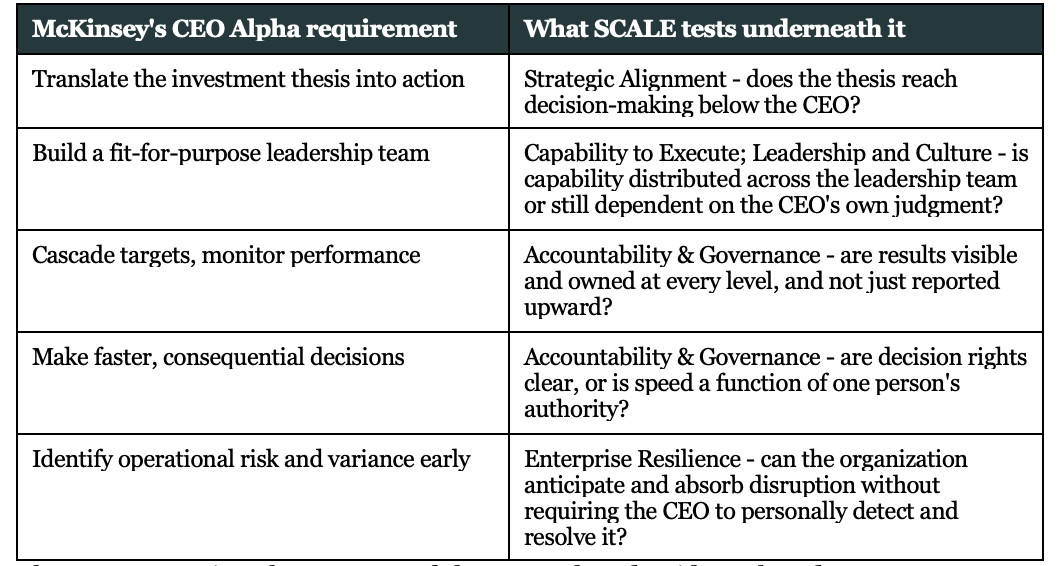
The assessment gives the sponsor and the CEO a shared, evidence-based answer to a question that is difficult to answer from the executive suite alone. No single vantage point, and that includes the CEO's, the sponsor's, or the board's, can fully reveal where capability has become embedded and where the organization still depends on individual intervention; that incomplete visibility is structural, not a personal failing. SCALE examines the consistency of strategic understanding, decision rights, execution capacity, accountability, and resilience across the board, the executive team, middle management, functional leadership, and customer-facing or frontline roles — and applies forward stress, testing not just how the organization is performing today but whether it can hold under the conditions it's about to face: accelerated growth, integration, a leadership change, or exit preparation.
What this means for diligence and hold-period strategy
For sponsors, the practical implication is straightforward. CEO assessment helps determine whether the company has the right person. Organizational diagnostics help determine whether that person’s capability is becoming an asset the company owns or remains a condition the company depends on. Both matter, and the risk of conflating them- treating a strong CEO as proof of a strong organization- is where portfolio companies quietly overstate their readiness for exit, for scale, or for a change at the top.
The distinction is most useful when applied at specific moments, not as a one-time read: early in the hold period, to establish an organizational baseline; before a major add-on acquisition or a more aggressive growth plan, when the organization is about to be stressed; during CEO succession planning; and ahead of exit, to demonstrate transferable capability to a buyer's diligence team. Establishing that baseline early lets a sponsor see whether organizational capability is strengthening alongside financial performance. Repeating the assessment before a major transition shows whether improvement has become embedded — or whether strong results still depend disproportionately on a few individuals.
The strongest CEOs don't just deliver the value-creation plan. They build an organization that continues executing without every critical decision and intervention routing through them. That is the difference between value created by a leader and capability owned by the enterprise, and it's a difference sponsors should assess with evidence, not infer from performance alone.