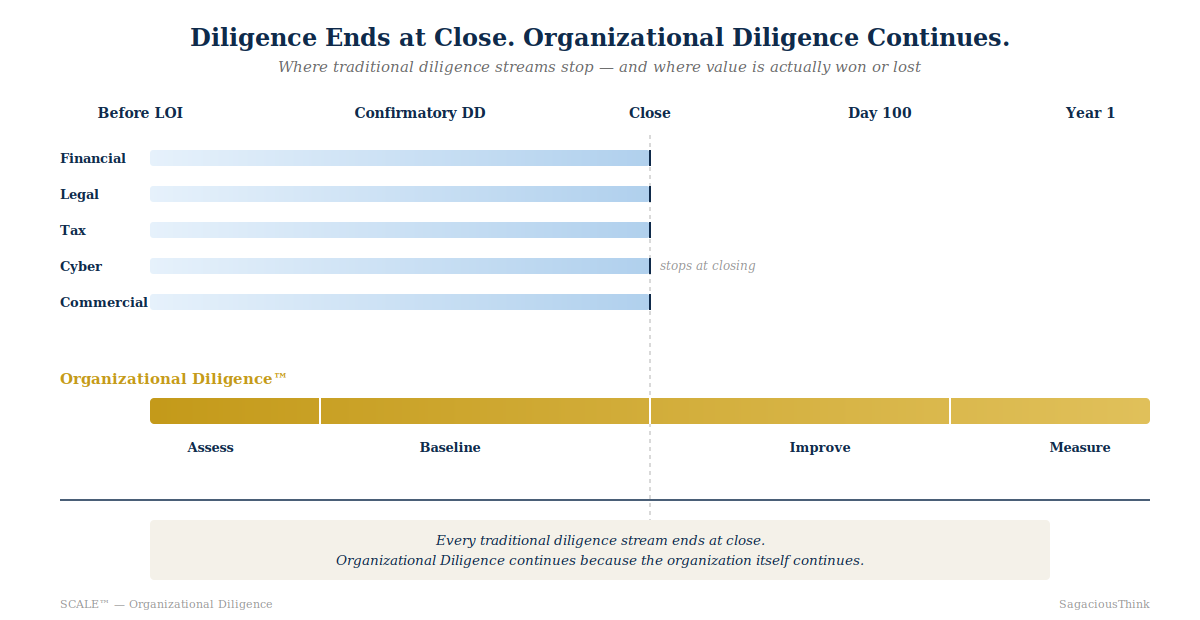
Financial diligence tells you what a company has produced. It rarely tells you whether the leadership, governance, operating discipline, and execution capability behind those results will hold up once ownership changes.
The Gap Traditional Diligence Leaves Open
Despite decades of advances in financial, legal, tax, cyber, and commercial diligence, studies continue to estimate that 70–90% of acquisitions fail to deliver their expected value. Individual studies disagree on the primary cause, but they consistently point to organizational factors: leadership, execution, culture, decision-making, and integration, as where value is ultimately won or lost.
They aren't separate problems. They're the same organization, viewed at two different points in time. Before closing, those conditions appear as diligence questions. After closing, they appear as integration challenges.
If the leadership bench is thin, decisions are concentrated in one founder, or governance hasn't matured for the next stage of growth, those conditions do not always announce themselves in a data room. They emerge months later as integration delays, unexpected attrition, slower decision-making, and unrealized value creation. The financial thesis wasn't wrong. The organization behind it just couldn't carry it.
What Organizational Diligence Evaluates
Alongside financial, legal, tax, cyber, and commercial diligence, Organizational Diligence™ answers the questions those workstreams aren't built to ask:
Can this leadership team scale beyond its current stage?
Where does critical knowledge or decision-making depend on a handful of individuals?
What conditions could erode enterprise value during the first twelve months after closing?
From Diligence to Continuity of Value
Traditional diligence concludes at closing. The findings are archived, the transaction team moves on, and operating leaders begin integration with only a partial picture of how the organization actually functions.
Organizational Diligence creates something different. The same assessment that informed the investment decision becomes the operational baseline for the first year of ownership. Leadership priorities become integration priorities. Governance gaps become board agendas. Founder dependencies become succession plans. Decision bottlenecks become operating improvements.
Instead of starting over on Day One, the organization begins with a shared understanding of where value is most likely to accelerate, or erode.