
Every seller prepares the numbers. Far fewer prepare the organization behind them, and that's often where buyer confidence, deal certainty, and ultimately valuation are won or lost.
The Gap Traditional Diligence Leaves Open
Despite decades of advances in financial, legal, tax, cyber, and commercial diligence, studies continue to estimate that 70–90% of acquisitions fail to deliver their expected value. While individual studies may disagree on the primary cause, they consistently point to organizational factors, such as leadership, execution, culture, decision-making, and integration, as where value is ultimately won or lost.
That risk doesn't start with the buyer. It starts with what's already true about your organization, whether or not anyone has looked closely yet. Before closing, those conditions surface as diligence questions. After closing, they surface as integration challenges. Either way, they surface. The only question is whether you discover them first, or your buyer does.
What Buyers Are Already Asking
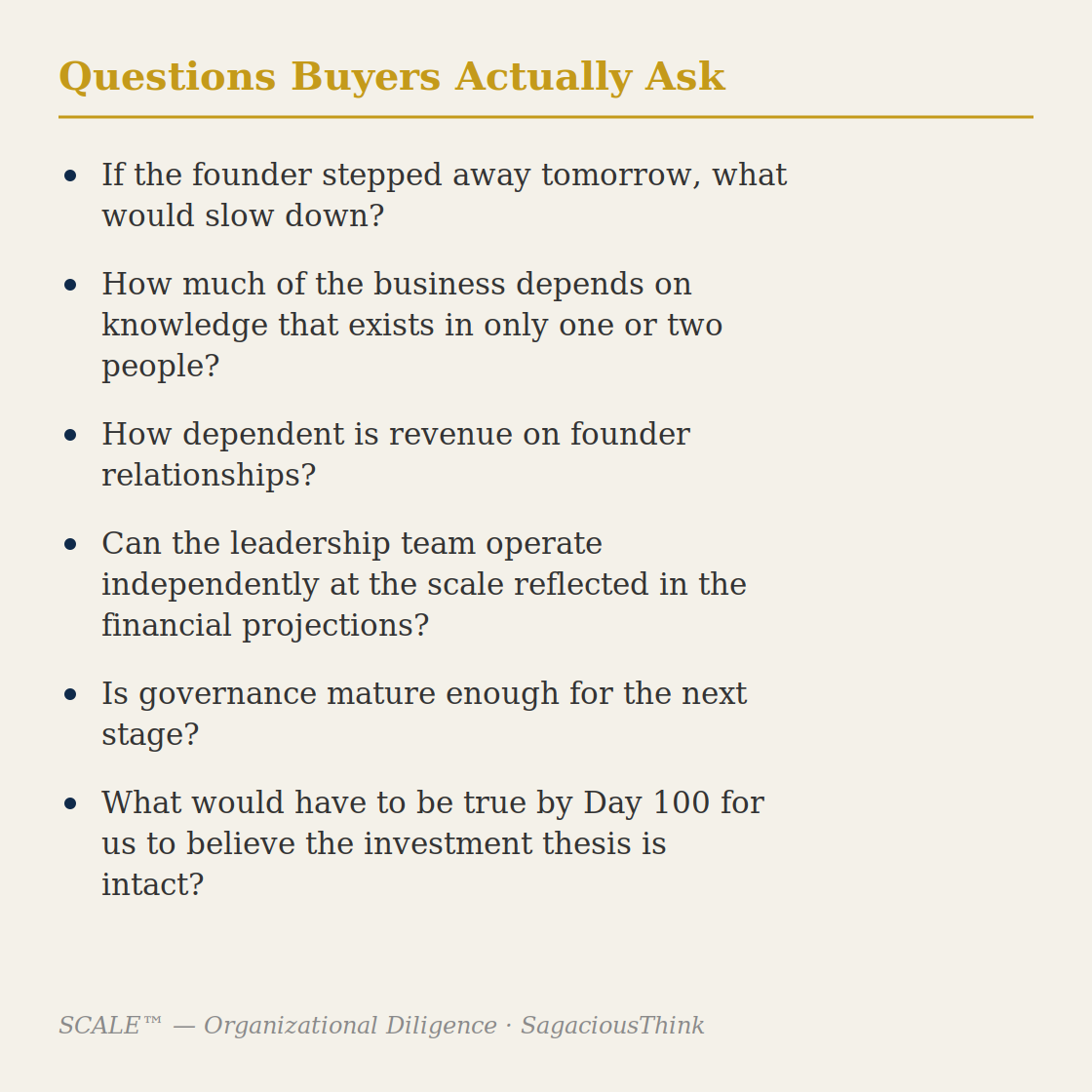
Every experienced buyer's diligence process eventually asks questions like these; whether or not you've prepared for them:
Can your leadership team operate independently at the scale reflected in your projections; before a buyer has to ask?
If you stepped away tomorrow, what would slow down, and where is that dependency concentrated?
What would have to be true by Day 100 for a buyer to believe the thesis they underwrote is still intact?
Organizational Diligence™ gives you the answers before someone else goes looking for them.
What Diligence Will Find
These conditions surface either way — before closing as diligence questions, or after closing as integration challenges. The only variable is who finds them first.
Strengthening the Story Before the Market Writes It
Entering a process without knowing your own organizational risk means finding out from the buyer's advisors, at the exact moment you have the least leverage to respond. Entering with that picture already in hand changes the conversation entirely: what's genuinely strong can be documented and demonstrated with confidence; what's fixable can be addressed before it becomes a negotiating point instead of after.
This isn't about hiding weaknesses. It's about knowing them first, on your terms, while there's still time to act.
Preparing your organization for diligence isn't just about achieving a stronger transaction. It's about giving the next owner confidence in what you've built and ensuring the organization you've spent years creating is ready for what comes next.
The best sale processes don't begin when the data room opens. They begin months earlier, when leadership chooses to understand the organization as honestly as a buyer eventually will.