
A Skill on the Board Does Not Make a Board Capability
New research maps what experience sits in Fortune 100 boardrooms. That is a useful place to begin assessing board capability. It is not where to end it.
The two sides of resilience
Deloitte asked 739 board directors and C-suite executives what drives long-term organizational resilience. Of the responses, 38% named board composition, and open communication between the board and the CEO was named considerably more often, by 66%.
The research that followed examined the first of those two. Drawing on BoardEx records of the six most recent leadership roles held by 1,183 Fortune 100 directors, Deloitte's Center for Board Effectiveness mapped what career experience is present in the largest American boardrooms. It is an insightful read, as it describes career history as a baseline for refreshment discussions and director education, not as a complete assessment.
My question, and the focus of this article, is what comes after the baseline.
A stronger starting point than the skills matrix
Most boards already document composition through a proxy-statement skills matrix. Those matrices are self-reported, and the underlying definitions can vary considerably. A former corporate secretary described being taken aback each year by how many directors on her board claimed legal expertise despite none being lawyers. When pressed, they pointed to experiences such as negotiating a contract. No one shared a common definition of expertise.
Career titles are harder to apply as generously. Mapping which leadership roles someone held, and for how long, is a more disciplined instrument than asking a board to describe itself.
Boards are not unaware of the need to look at themselves. PwC's 2025 Annual Corporate Directors Survey found that 78% of directors did not believe their assessment process gave a complete picture of board performance, and nearly three-quarters said their boards conducted no individual director assessments at all. The problem is not an absence of evaluation, but the limits of what the evaluation can see.
That’s not to say the skills matrix is unimportant. A Spencer Stuart survey of 932 public- and private-company directors found that 67% of boards executing succession strategies used skills matrices, and directors rated them among the most effective refreshment tools in the survey. It is a foundation rather than a complete reading, and it becomes considerably more useful once connected to how capability is distributed, whether it is being used, and how long it will remain available.
What Deloitte surfaces is a concentration in traditional executive experience. Every Fortune 100 company CEO sits on their company's board, and 53 also chair it. Beyond the current CEO, every one of those boards includes at least one other director with CEO experience. Directors who came up through finance appear on 96 boards; operations executives on 89.
The less represented areas are where the results get interesting. Directors with senior technology leadership experience serve on only 38 boards and represent just under 6% of all Fortune 100 directors. Research and analytics leadership is rarer still: 41 individuals, about 3% of directors, spread across 28 boards. Another way of looking at it is that 62 boards lack a director with senior technology experience, and 72 lack one with either current or recent research and analytics experience.
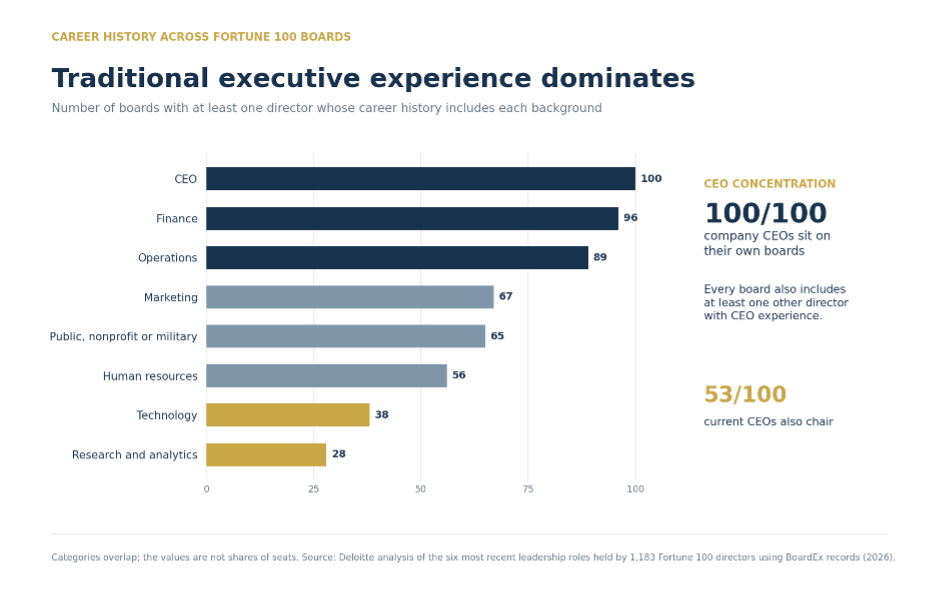
Career backgrounds represented across Fortune 100 boards. Categories overlap; each bar shows the number of boards with at least one director whose career history includes that background. Source: Deloitte analysis of BoardEx records.
A Spencer Stuart survey of nominating and governance committee chairs put technology experience second only to CEO and COO backgrounds among recruitment priorities. Boards say they want it, but their board composition has not caught up.
Nor is this solely a large-company question. A 2024 survey of 746 private companies found that 72% of them had revenue between $11 million and $500 million and a median board size of seven. The boards were approximately half insiders and half independent directors. Thirty-seven percent had dual CEO/ chair roles, only 24% had an outside chair, and 29% had a lead independent director. When respondents were asked what would enhance board effectiveness, adding specific expertise topped the list at 48%.
The survey's authors found several similarities between private- and micro-cap public-company governance practices, while noting less independent board leadership among private companies. The middle market is not simply a smaller version of the Fortune 100. However, smaller boards, greater insider representation, and fewer independent leadership mechanisms can make the concentration of capability more consequential.
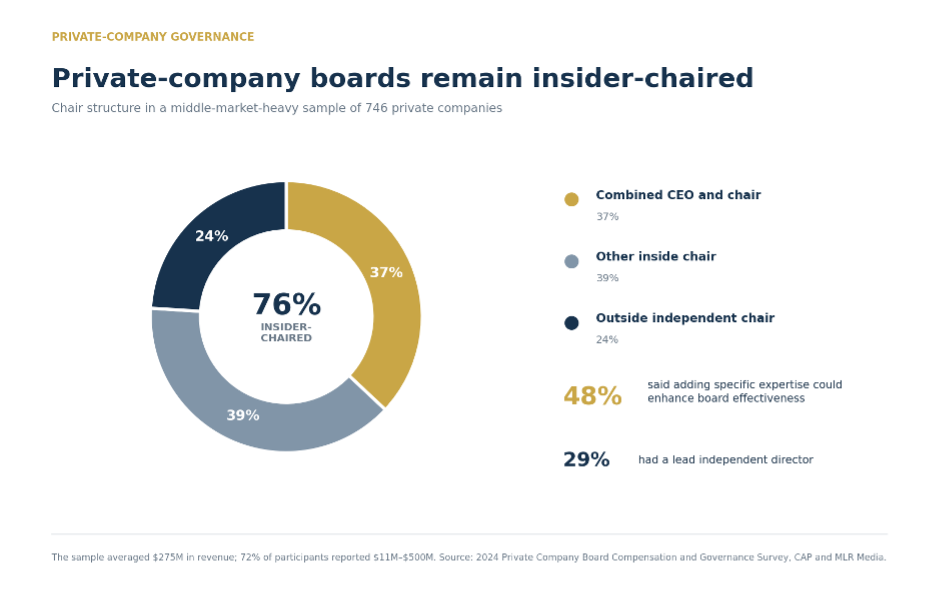
Board-chair structure among surveyed private companies. The survey sample averaged $275 million in revenue, with 72 percent of participating companies between $11 million and $500 million. Source: 2024 Private Company Board Compensation and Governance Survey.
If you are a director reading this, what does your board's composition look like?
Presence is not coverage
That question can be answered. It simply answers less than it appears to.
An ”at least one” measure establishes apparent presence. It cannot tell a board whether the capability is concentrated in a single person, understood widely enough to support real deliberation, actively used in decisions, or likely to leave with the next director rotation.
Meaningful coverage should be tested at three levels: an anchor who has led the function and can be relied on for depth; the ability to interpret, often a secondary director who can challenge the anchor and translate the domain for colleagues; and sufficient literacy across the rest of the board to participate rather than defer blindly.
Consider AI and technology governance on an illustrative seven-director board. One director is a former technology executive with current experience overseeing enterprise technology and alone indicates the board's depth. A second director has enough working knowledge to challenge assumptions and translate technical issues into strategic implications. Three possess the baseline literacy needed to ask informed questions and participate in deliberation. The remaining two largely depend on their colleagues' interpretation.
A conventional skills matrix may record that this board has technology expertise. It may even show several directors checking the same box. What it will not necessarily reveal is that deep capability resides with one person, that the ability to meaningfully challenge exists, or that two directors cannot yet engage independently.
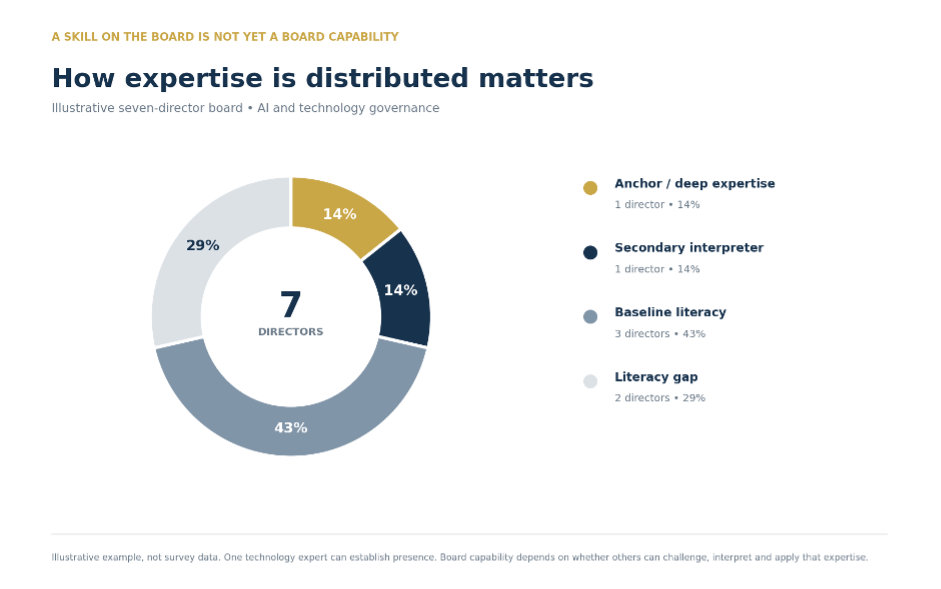
Illustrative example, not survey data. One technology expert can establish presence. Board capability depends on whether others can challenge, interpret, and apply that expertise.
This chart is neither an example of a deficient board, nor a prescription of an ideal percentage. It reveals where capability is strong and where it remains dependent. If the anchor leaves, becomes unavailable, or does not contribute actively, can the board still question management's assumptions, interpret the implications of an AI-related decision, and exercise sound governance judgment? That is the difference between having a skill represented and possessing a durable board capability.
This is why coverage must be read as a pattern rather than a count. In the SCALE Board Value Diagnostic, every domain resolves to one of four patterns: well distributed, anchor only, shallow spread, or literacy gap. Several of those conditions can appear adequately covered on a conventional matrix. Even where the matrix reveals how many directors claim a skill, it rarely distinguishes depth from exposure, current practice from dated experience, or active contribution from nominal presence.
The distinction becomes more critical as boards get smaller. A twelve-person board can plausibly carry a specialist for each emerging domain. A seven-person board cannot solve every new requirement with another appointment. It needs directors who bring several relevant capabilities at once, and enough shared literacy across the table that no single domain becomes one person's private territory. Refreshment for smaller boards cannot carry the whole burden alone to ensure the right skill set exists.
Coverage is not contribution
Suppose the capability is genuinely present and reasonably distributed. A second question remains: is it being used?
Directors themselves answer that question, and they have their own opinions. In PwC's survey, 55% said at least one of their board colleagues should be replaced, marking the first time a majority had said so, and a six-point rise in a single year. The reasons were telling: 41% cited a colleague who does not contribute meaningfully to discussions, 34% cited diminished performance associated with long tenure. 21% cited a lack of relevant expertise, and 20% cited an interaction style that harms board dynamics.
Three of the four leading reasons concern what happens after expertise enters the boardroom and whether a director continues to contribute, engage, and interact effectively rather than whether the résumé held the right experience in the first place. A career history can establish why someone entered the boardroom, but it does not determine what the board receives from that experience now.
The SCALE Board Value Diagnostic does not take resumes or self-assessment at face value. Each director rates their own presence and activation across every governance domain, and every other director rates them on the same dimensions, anonymously. Activation carries more weight than presence in the resulting score for a straightforward reason: expertise that remains undeployed contributes limited governance value.
Layered on top are three behavioral readings taken at the director level rather than domain by domain:
- Strategic translation: Does the director connect their expertise to the specific strategic opportunities, risks, and decisions facing this company, rather than to the domain in general?
- Technical expression: Is that connection communicated in a way other directors understand and can readily apply?
- Governance judgment: Does the director move past explaining an issue to offering practical judgment that helps the board clarify priorities and assess tradeoffs, without stepping into management's role?
Where a director's self-assessment and colleagues' assessments diverge materially, that divergence is itself a governance finding. It is common, rarely visible, and absent from composition data.
Academic literature independently arrives at the same place. A 2025 study in the Journal of Business Research examined 32 private-company boards using responses from multiple directors on each. Access of this kind is unusual in board research, and the multi-respondent design allows the study to observe a board rather than poll disconnected individuals about one. It found that directors' awareness of one another's knowledge and skills improved board service performance indirectly through shared leadership, the process by which the board integrated what its members knew.
Knowing who holds which expertise matters as it can inform the board what to do with that knowledge.
Capability must be durable
The same director who establishes that a capability is present can also be the reason it is fragile. When one director holds a domain at practitioner or expert level and is approaching the end of their term, the board is not simply strong in that domain. It is strong for a finite period.
Board Value explicitly flags that condition, separating the sole holder whose departure removes a capability outright from the primary holder whose departure creates concentration risk. It also raises a distinct prompt where a committee-chair role has no identified successor in development. An advisory seat can partially offset an exposure; it does not replace director-level coverage.
A skills matrix is a snapshot of the board as constituted, but most do not show the cliff.
Different deficiencies require different responses
Deloitte proposes two levers: align refreshment with future priorities and build capability between refreshment cycles through education. Both are sound suggestions, but neither is a panacea, because at least five distinct conditions can look alike on a skills matrix.
- Absent: Nobody has the capability. This is principally a composition problem, answered by recruitment or supplemented temporarily by retained expertise.
- Concentrated: One anchor holds the depth, with no secondary interpreter. Recruitment may help; building broader literacy can reduce reflexive dependence.
- Inactive: The capability is in the room but is not entering deliberation. Recruitment alone will not fix it.
- Untranslated: The expertise exists but does not reach colleagues in usable form.
- Departing: The capability is likely to leave through rotation or succession. Neither recruitment nor education will help if the board starts too late.
Board Value separates interventions accordingly: those that are compositional, requiring recruitment or development, and those that are compositional plus behavioral, requiring process and culture change alongside any change in personnel. Recruiting a technology director will not cure deference to a technology director. Education can broaden literacy and reduce that deference; it cannot instantly reproduce the depth held by the board's sole practitioner. Identifying which condition exists is the assessment. Prescribing before that is guesswork with a budget attached.
The question after composition
The Composition tool tells a board what capabilities it can bring to oversight. Board Value examines whether that expertise is present, distributed, activated, and durable at the director and domain levels. BoardPulse examines the operating conditions relevant to the board's information gathering, relationships, culture, and governance practices that determine whether it can effectively use those capabilities.
That ability to gather that second reading matters, as Deloitte's own respondents ranked open communication between the board and CEO ahead of composition as a driver of resilience. Knowing what expertise is in the room does not reveal whether the board receives the information, has the relationships, or creates the conditions necessary for that expertise to influence governance.
None of this diminishes what the research establishes. Knowing who is in the room is a real prerequisite and measuring it through career history rather than self-description offers an improvement on the standard practice. But a board that stops at the roster has answered the easiest question available to it.
When your board last reviewed its skills matrix, did it ask only who had the experience, or where that capability changed the quality of a decision?
Sources: Christine Davine, Jamie McCall, Timothy Murphy, Elizabeth M. Molacek and Caroline Davis Schoenecker, “What directors' career histories may reveal about the capabilities of Fortune 100 company boards,” Deloitte Insights, April 2026, republished by the Harvard Law School Forum on Corporate Governance, June 2026. PwC, 2025 Annual Corporate Directors Survey, October 2025. Spencer Stuart, Director Pulse Survey: Board Refreshment and Director Succession Planning, March 2025, and Nominating/Governance Chair Survey, July 2025. Wim Voordeckers, Alana Vandebeek, Frank Lambrechts, Yannick Bammens and Maarten Vandewaerde, “Director knowledge, shared leadership, and board service performance,” Journal of Business Research, vol. 189, 2025.
https://corpgov.law.harvard.edu/2026/06/25/what-directors-career-histories-may-reveal-about-the-capabilities-of-fortune-100-company-boards/