sage ideas | fresh perspective | sustained success

Insights

Periodic musings

Posts in business operations
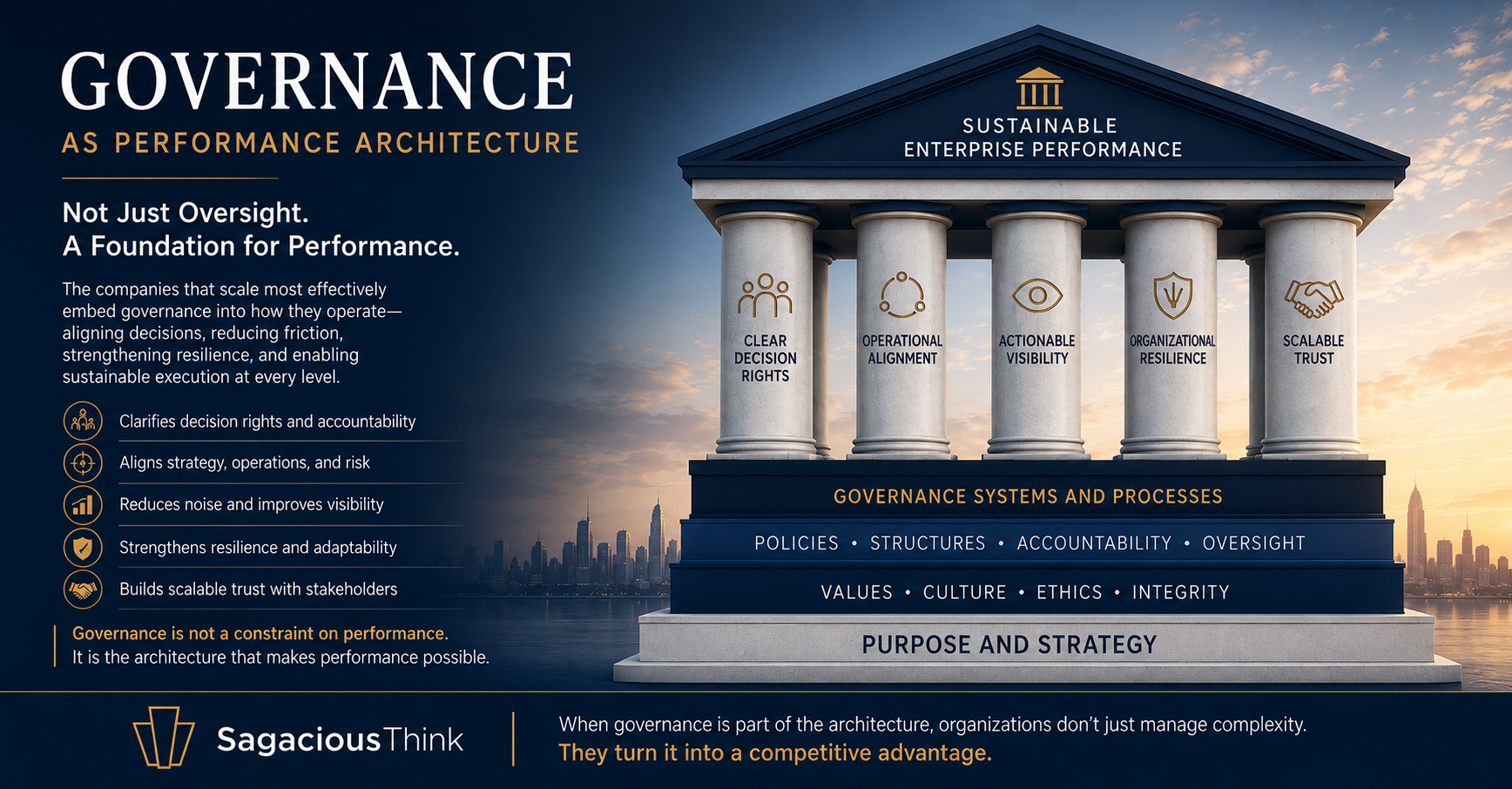
Governance as Performance Architecture

Most companies do not realize they have a governance problem until growth starts creating friction.

Decisions slow down.
Coordination weakens.
Risks surface too late.
Leadership becomes the bottleneck.

At a certain point, every organization reaches a complexity threshold where informal leadership systems stop scaling effectively.

The companies that navigate this successfully understand something important:

Governance is not bureaucracy layered onto performance.

It is part of the architecture that makes performance possible.

In this article, I explore:
• why governance failures are often actually execution failures,
• how structural friction quietly undermines scaling companies,
• why governance maturity increasingly shapes operational performance,
• and how organizations can build governance into the architecture of execution itself.

Including:

  • a real-world scaling case study,

  • leadership and board discussion questions,

  • and practical insights for organizations navigating increasing complexity.
Read More
When Growth Outpaces Structure

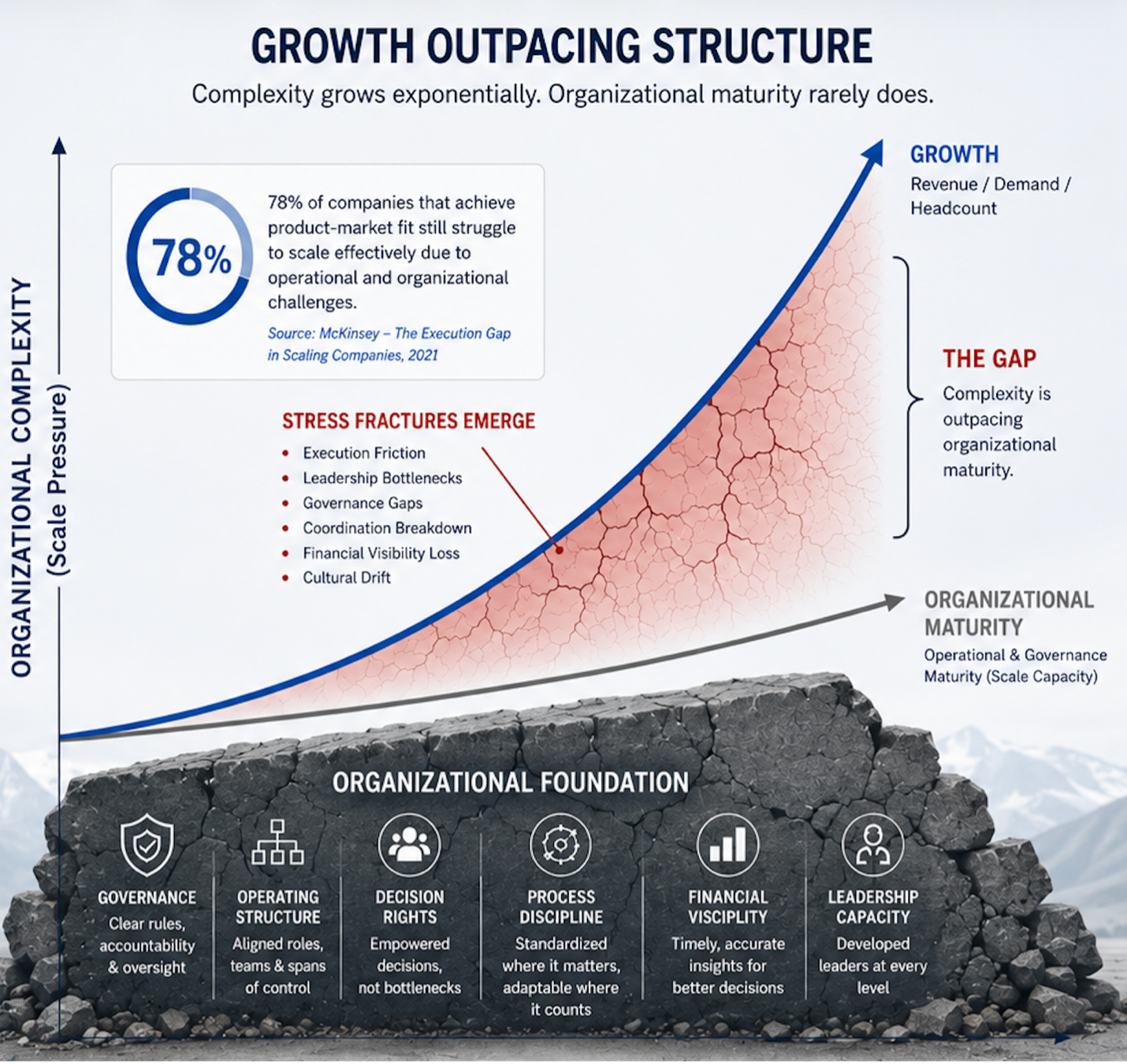
Growth does not simply create more work. It changes the operating conditions of the organization itself.

As middle market companies scale, complexity expands across operations, governance, risk oversight, decision-making, cross-functional coordination, cybersecurity, AI adoption, regulatory exposure, and leadership accountability. Yet many organizations continue operating with structures designed for a much smaller business.

The result is often not immediate failure, but growing organizational strain: slower decisions, leadership bottlenecks, execution friction, governance gaps, declining operational visibility, and hidden enterprise risk that boards and leadership teams may not fully see until performance begins to suffer.

This article explores why scaling challenges frequently emerge not because growth opportunities are weak, but because organizational maturity, governance discipline, and operational structure are not evolving at the same pace as organizational complexity.

Read More
The Ethical Compliance Wall for Globally Focused SMEs

Building on my last article about the challenges facing SMEs considering global expansion, I wrote about the challenges of hitting the “ethical compliance wall.”

The "Ethical Compliance Wall" is the point at which an SME's global growth is no longer limited by sales or logistics, but by its ability to provide legally auditable proof of its environmental and social impact.

In 2026, the era of "voluntary reporting" is effectively over. Large multinationals are now legally liable for their entire supply chains, meaning they are aggressively offloading their compliance burdens onto their SME partners.

Read More
Going global in 2026 has a new set of challenges for SMEs

The dream of global expansion has fundamentally shifted. That "low-cost, high-speed" playbook of the past decade has been replaced by one with a focus on the "high-resilience, high-compliance" reality. For small and medium-sized enterprises (SMEs), the barriers to entry are no longer limited to finding a distributor of a local salesperson; those barriers include navigating a fragmented geopolitical landscape and meeting rigorous new digital and ethical standards.

Read More
Case Study: Hilton's Response to Their Franchise

There are lessons to be considered in Hilton’s response to one of their franchisees' refusals to serve federal agents earlier this month in Minnesota.  

Background:  A franchise property (under the Hilton/Hampton brand) gained media attention when it was reported that it canceled reservations for federal government employees tied to the recent anti-immigration efforts. Hilton quickly stripped the hotel of its branding for refusing service to federal agents.

For leaders of Small and Medium Enterprises (SMEs), this is not just a "big brand" problem. It is a cautionary tale about how decentralized operations can create reputational issues that need to be swiftly addressed.

Read More