

Most board directors still treat cybersecurity as something they oversee: a dashboard, a quarterly report, a briefing from the CISO. That framing is now incomplete.
Directors are not just governing cyber risk. They are increasingly part of the attack surface itself, in an environment where AI has dramatically lowered the cost, speed, and precision of attacks, the gap between what directors assume about their own exposure and what adversaries already understand is rapidly widening.
Read More
Corporate governance is undergoing a structural shift driven by three forces: AI oversight, geopolitical influence on governance frameworks, and evolving expectations around transparency and board composition. Across the United States, Europe, Asia, Africa, and the Middle East, regulators, investors, and institutions are redefining what effective governance means in an environment where technological risk, geopolitical influence, and stakeholder trust increasingly intersect.
The result is a transition from governance focused primarily on financial oversight and compliance toward governance that must now incorporate technology oversight, geopolitical awareness, and broader stakeholder transparency. Boards that fail to adapt risk not only regulatory exposure but also strategic blind spots as technology and regulatory environments evolve faster than traditional governance frameworks.
Read More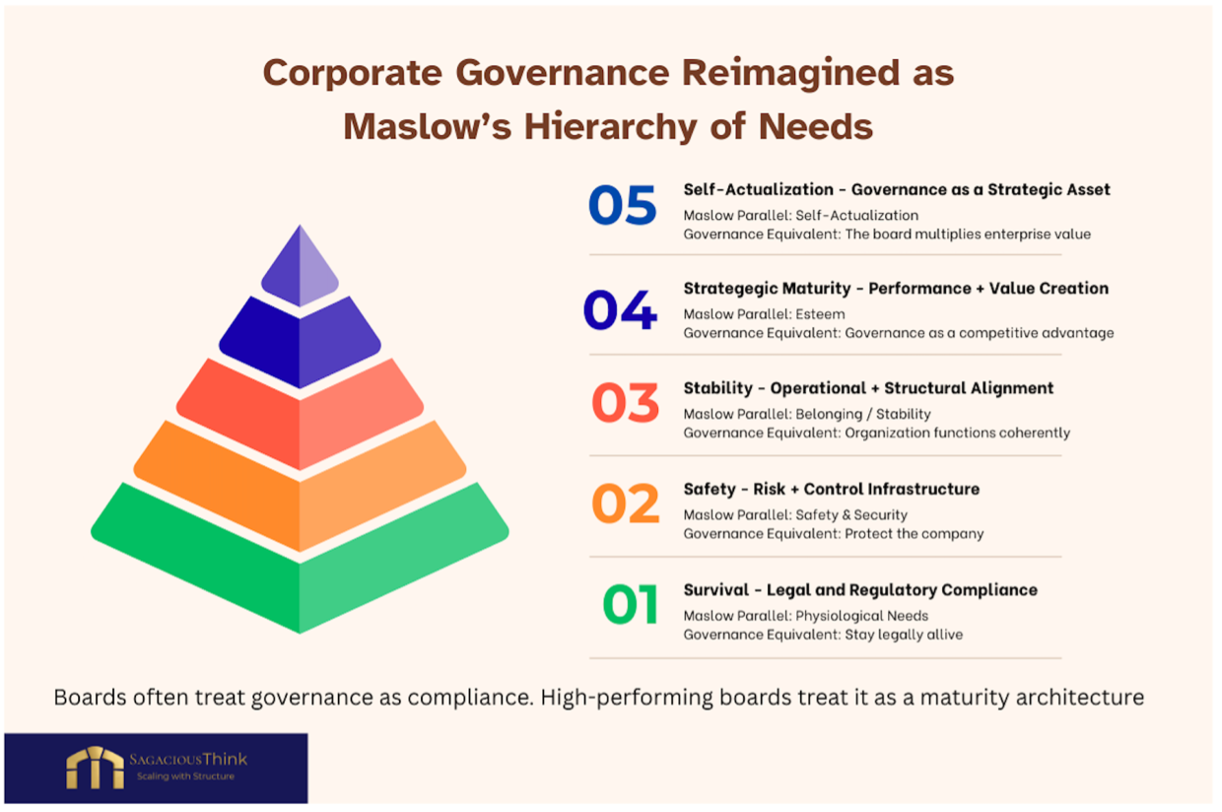
We talk about leadership maturity. Operational maturity. Cultural maturity. We rarely talk about governance maturity. But your board has a hierarchy of needs just like everything else — and most are stuck somewhere between survival and safety, calling it strategy.
Read More