
The Most Dangerous Scaling Problem Is Imbalance
Many scaling companies appear far from dysfunctional from the outside, as revenue may still be growing, hiring may still be accelerating, and customer count may still be increasing. Yet internally, strain begins to emerge across coordination, decision-making, accountability, and execution.
Leaders begin feeling it first:
decisions slow,
communication fragments,
priorities collide,
leadership bandwidth narrows,
accountability becomes inconsistent,
and teams begin working harder simply to maintain momentum.
The issue is the result of the imbalance, not necessarily weakness.
Organizations rarely fail because every area is weak (they would not have achieved the results they had if that were the case); they struggle because growth creates an imbalance between strategy, capability, leadership, governance, accountability, and resilience. At scale, uneven maturity becomes structural strain, and this is one of the central realities behind the SCALE framework.
The SCALE framework examines organizational maturity across interconnected dimensions of
S – Strategic Alignment
C – Capability to Execute
A - Accountability & Governance
L – Leadership & Culture
E - Enterprise Resilience.
The framework recognizes that scaling problems rarely emerge because every capability is weak simultaneously. More often, organizations become structurally imbalanced as certain dimensions mature faster than others. Over time, complexity exposes those gaps.
Scaling Is Never Symmetrical
One of the most dangerous assumptions in scaling organizations is believing that strengths in one area can indefinitely compensate for weaknesses in another.
Strong leadership cannot permanently offset weak systems, and an exceptional strategy cannot indefinitely compensate for insufficient operational maturity. High operational output certainly does not eliminate exposure to resilience risks; it just may cover for it temporarily. Organizations scale unevenly, as they are focused on, and resources are applied inconsistently; some capabilities mature rapidly while others lag. Growth can do a great job of temporarily masking those gaps, but complexity keeps the organization honest by eventually exposing them. This is where many organizations begin paying what might be called the “complexity tax”:
unnecessary escalation,
duplicated effort,
KPI conflict,
delayed visibility,
leadership overload,
operational friction,
and rising organizational fatigue.
The danger is allowing organizational maturity to evolve unevenly as complexity increases.
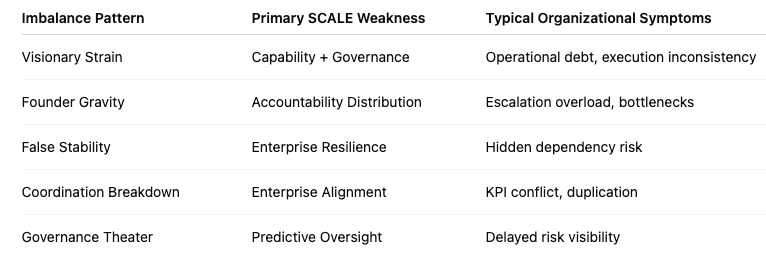
The SCALE Imbalance Patterns
While every organization is unique, recurring patterns of imbalance appear across scaling companies. These patterns are often visible long before financial underperformance appears.
1. Visionary Strain
High Strategy / Low Capability Maturity
Some organizations possess exceptional vision, market timing, and growth ambition, yet their operational systems fail to mature at the same pace, which results in organizational overstretch.
Symptoms often include:
constant reprioritization,
overloaded teams,
execution inconsistency,
expanding operational debt,
and increasing dependence on heroic effort.
A widely discussed example is WeWork, where rapid expansion and aggressive growth significantly outpaced governance and operational maturity. Governance concerns became highly visible during the company’s failed IPO process and subsequent restructuring.
Sources:
· Business Insider – WeWork IPO Timeline and Collapse
· The Rise and Fall of WeWork (case study PDF)
The lesson is not that ambition is dangerous; the lesson is that growth velocity without organizational maturity creates fragility. Governance concerns became visible during the company’s failed IPO process and subsequent restructuring, with widespread scrutiny focused on leadership concentration, governance practices, and operational sustainability.
Questions Leadership Teams Should Ask
Where are teams improvising instead of executing repeatable systems?
Which initiatives repeatedly stall during execution?
What operational strain is currently being masked by growth?
Questions Boards Should Ask
Is operational maturity scaling at the same pace as commercial growth?
What capabilities remain overly dependent on key individuals?
Where are leaders compensating manually for missing systems?
2. Founder Gravity
High Leadership Dependency / Low Accountability Distribution
In many scaling organizations, decision-making is heavily concentrated around a small number of individuals. Initially, this often feels like a strength as leadership moves quickly, the organization remains agile, and decisions are made quickly through proximity and intuition. However, as complexity grows, centralized leadership can become a bottleneck, where symptoms often include:
excessive escalation,
leadership exhaustion,
slow decision velocity,
inconsistent accountability,
and organizational hesitation.
This pattern frequently emerges in founder-led technology firms, PE-backed portfolio companies, and rapidly scaling international businesses. Organizations experiencing Founder Gravity often normalize dependency because growth is still occurring until leadership bandwidth becomes the limiting factor.
Questions Leadership Teams Should Ask
What decisions repeatedly return to senior leadership?
Where are teams waiting instead of deciding?
Which leaders truly own outcomes versus seek approval?
Questions Boards Should Ask
How concentrated is organizational authority?
Could the company sustain disruption if a key executive stepped away unexpectedly?
Is leadership scalability being intentionally developed?
3. False Stability
High Operational Output / Low Resilience
Some organizations appear operationally strong while carrying hidden structural exposure beneath the surface.
This is increasingly common in environments shaped by:
AI adoption,
cyber dependency,
global supply chains,
platform concentration,
and interconnected digital infrastructure.
The 2024 CrowdStrike outage became a powerful illustration of this reality.
A faulty software update disrupted millions of systems globally, impacting airlines, healthcare providers, banks, logistics networks, and government operations. Multiple observers described it as one of the largest IT outages in history.
The outage was not simply a technological failure, as it revealed how deeply interconnected operational ecosystems have become, and how concentrated dependencies can create systemic fragility.
Sources:
· Reuters – CrowdStrike Update Caused Global Outage
· Reuters – Experts Say Checks Were Likely Skipped
· Reuters – Global Disruptions Across Industries
· Wikipedia – 2024 CrowdStrike IT Outage Summary
Similarly, increasing scrutiny around AI governance, data privacy, and surveillance practices has shown that operational capability without governance maturity can create significant reputational and regulatory risk. The outage demonstrated how concentrated digital dependencies can create cascading operational disruption across globally interconnected ecosystems.
Questions Leadership Teams Should Ask
Which operational dependencies are least visible but most critical?
Have resilience scenarios been operationally stress-tested?
Where would information flow fail during a crisis?
Questions Boards Should Ask
What assumptions about operational continuity remain untested?
How mature is AI governance relative to AI adoption?
Which dependencies could materially impair operations within 30 days?
4. Coordination Breakdown
Strong Functions / Weak Enterprise Alignment
Organizations can possess highly competent individual functions and still struggle at the enterprise level. Functional excellence does not automatically create organizational alignment.
This pattern is common in:
post-M&A environments,
multinational expansion,
PE rollups,
matrix organizations,
and rapidly assembled executive teams.
Symptoms often include:
duplicated initiatives,
KPI conflict,
meeting overload,
inconsistent prioritization,
and cross-functional friction.
The organization appears busy, while simultaneously, enterprise execution slows. This is often where governance maturity becomes increasingly important, not as compliance, but as a coordination architecture.
Questions Leadership Teams Should Ask
Which teams repeatedly escalate coordination conflicts?
Where do priorities compete instead of reinforcing one another?
What decisions are routinely revisited due to alignment gaps?
Questions Boards Should Ask
Are executive incentives aligned with enterprise outcomes?
Where is coordination friction slowing execution?
Does leadership operate as an integrated system or a collection of functions?
5. Governance Theater
Formal Governance / Weak Operational Integration
One of the most dangerous forms of imbalance is when governance exists structurally but lacks meaningful operational integration. Organizations in this bucket can often point to:
dashboards,
committees,
policies,
reporting structures,
and formal oversight processes.
Yet visibility into emerging operational risk remains weak, as governance maturity is not measured by the volume of reporting. It is measured by whether governance improves:
decision quality,
accountability,
organizational visibility,
and resilience.
The ongoing governance scrutiny surrounding Boeing illustrates the consequences of oversight systems becoming disconnected from operational realities. Multiple analyses following the 737 MAX crisis pointed to concerns involving board oversight, safety visibility, reporting structures, and organizational culture.
Sources:
· U.S. House Transportation Committee Report on Boeing 737 MAX
· New York Times – Boeing 737 MAX Coverage Hub
Governance that is retrospective rather than predictive will lose effectiveness. Multiple investigations following the 737 MAX crisis raised concerns involving safety oversight, reporting structures, organizational culture, and board visibility into operational risk.
Questions Leadership Teams Should Ask
Are dashboards driving action or documenting problems?
Which risks are discussed repeatedly without resolution?
What information reaches leadership too late?
Questions Boards Should Ask
Does the board receive visibility into emerging operational strain early enough?
Are metrics predictive or historical?
Where does oversight remain weakest relative to organizational complexity?
Complexity Compounds
Scaling challenges rarely emerge in isolation because organizations often experience multiple imbalance patterns simultaneously.
Founder Gravity may coexist with Coordination Breakdown, and Visionary Strain frequently accelerates False Stability. Governance Theater often masks resilience weakness until disruption occurs. For these reasons, scaling problems can feel difficult to diagnose. The issue is often not one broken function; it is the interaction between unevenly matured systems.
Diagnostic Reflection for Boards and Leadership Teams
As organizations scale, imbalance can appear long before a crisis. The key is recognizing the signals early enough to respond intentionally.
Strategic Alignment
Which SCALE pillar is currently strongest?
Which pillar is most dependent on individuals rather than systems?
Where is organizational friction increasing fastest?
Leadership Scalability
What decisions still depend excessively on executive escalation?
Where are leaders becoming operational bottlenecks?
What happens if growth doubles from here?
Governance & Oversight
Does governance improve execution quality or merely document outcomes?
Are emerging operational risks visible early enough for meaningful intervention?
Is board oversight increasingly predictive or still largely retrospective?
Organizational Resilience
What assumptions about scalability remain untested?
Which dependencies create the greatest hidden fragility?
Where could a single disruption cascade across the enterprise?
Enterprise Coordination
Are incentives aligned around enterprise performance or silo optimization?
Where are teams duplicating effort due to coordination gaps?
Which cross-functional tensions are becoming normalized?
Final Thoughts
Scaling problems begin with friction that organizations normalize:
· slower decisions,
· leadership overload,
· coordination fatigue,
· delayed visibility,
· rising operational strain
The danger is allowing organizational maturity to evolve unevenly as complexity increases because eventually, imbalance becomes structural. Its the structural strain that eventually becomes operational risk.