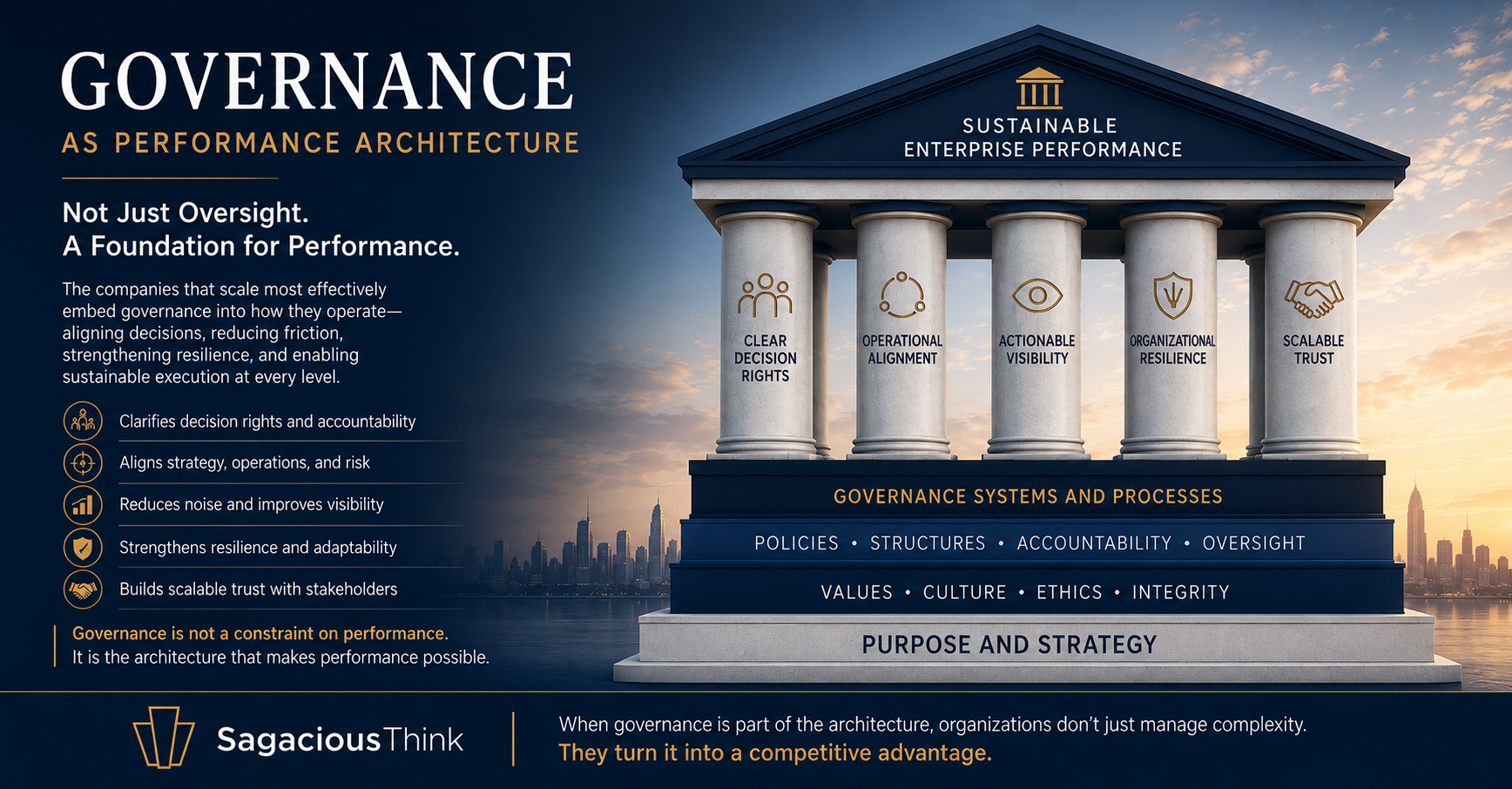
Most companies do not realize they have a governance problem until growth starts creating friction.
Decisions slow down.
Coordination weakens.
Risks surface too late.
Leadership becomes the bottleneck.
At a certain point, every organization reaches a complexity threshold where informal leadership systems stop scaling effectively.
The companies that navigate this successfully understand something important:
Governance is not bureaucracy layered onto performance.
It is part of the architecture that makes performance possible.
In this article, I explore:
• why governance failures are often actually execution failures,
• how structural friction quietly undermines scaling companies,
• why governance maturity increasingly shapes operational performance,
• and how organizations can build governance into the architecture of execution itself.
Including:
a real-world scaling case study,
leadership and board discussion questions,
and practical insights for organizations navigating increasing complexity.