When chief executives need to make sense of what lies ahead, many turn to other CEOs more readily than to their own directors or chair. That does not necessarily indicate a failing board. It raises a more revealing question: if relevant experience is already present around the board table, why does the CEO seek it elsewhere? The answer may lie less in what directors know than in trust, timing and whether their knowledge can enter the conversation before a strategic direction has hardened.
Read MoreMost board directors still treat cybersecurity as something they oversee: a dashboard, a quarterly report, a briefing from the CISO. That framing is now incomplete.
Directors are not just governing cyber risk. They are increasingly part of the attack surface itself, in an environment where AI has dramatically lowered the cost, speed, and precision of attacks, the gap between what directors assume about their own exposure and what adversaries already understand is rapidly widening.
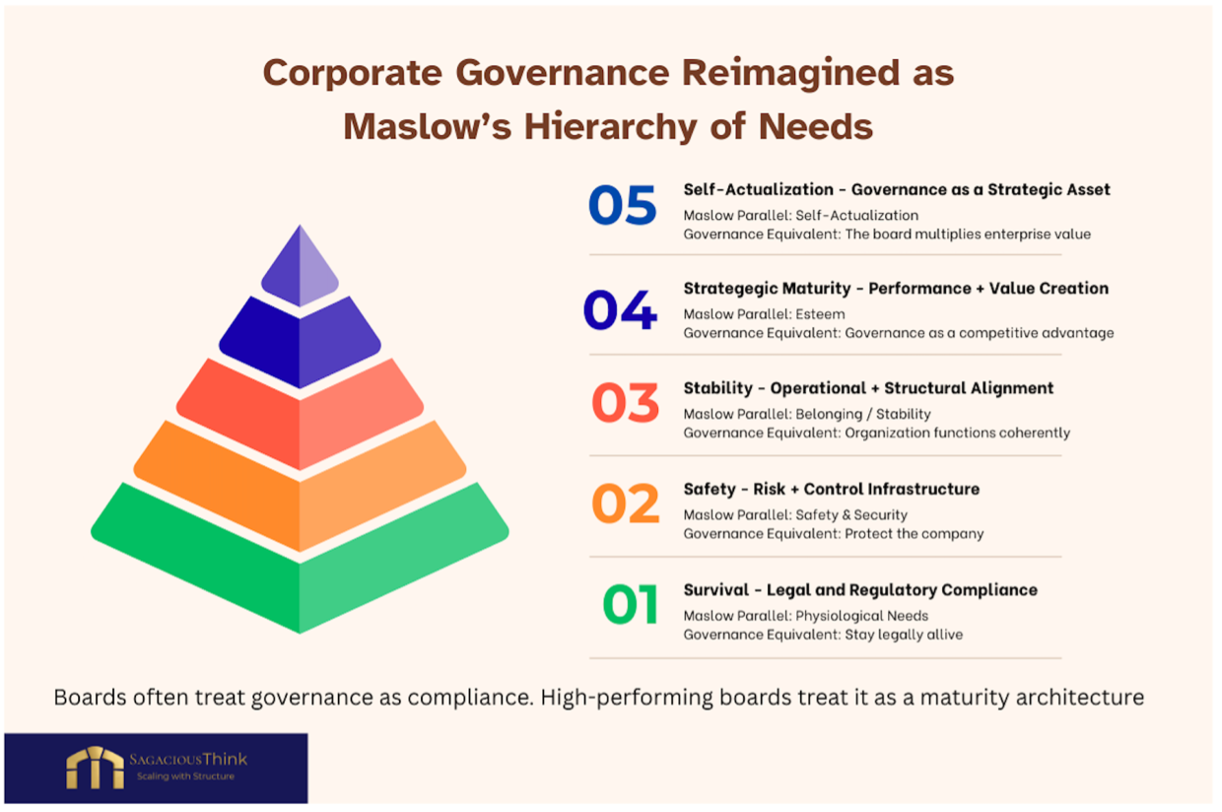
Read MoreWe talk about leadership maturity. Operational maturity. Cultural maturity. We rarely talk about governance maturity. But your board has a hierarchy of needs just like everything else — and most are stuck somewhere between survival and safety, calling it strategy.
Read MoreBuilding on my last article about the challenges facing SMEs considering global expansion, I wrote about the challenges of hitting the “ethical compliance wall.”
The "Ethical Compliance Wall" is the point at which an SME's global growth is no longer limited by sales or logistics, but by its ability to provide legally auditable proof of its environmental and social impact.
In 2026, the era of "voluntary reporting" is effectively over. Large multinationals are now legally liable for their entire supply chains, meaning they are aggressively offloading their compliance burdens onto their SME partners.
Read More